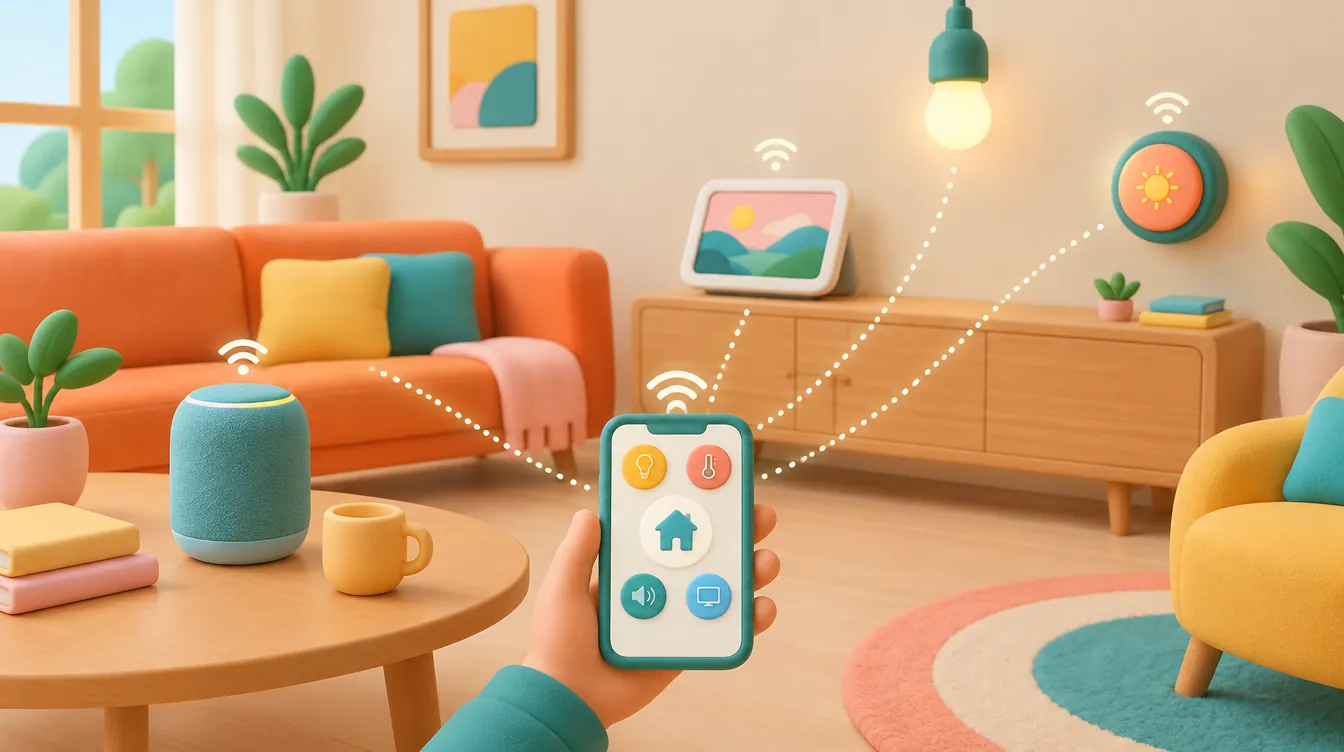
The best smart home starter kit is not a shrink-wrapped bundle of five mismatched gadgets. It is a small, compatible set of hardware built around one daily routine—such as automating a bedside lamp at sunset or cutting phantom draw on a living room space heater—using an app and voice assistant your household already relies on. Spending $40 on one Matter-certified controller or plug that works reliably every morning beats spending $150 on a discounted holiday box full of proprietary sensors that end up disconnected in a drawer.
Choosing between Amazon Echo (Alexa), Google Nest (Google Home), and Apple HomeKit (Apple Home) comes down to the phones in your household and the radios built into your first controller. While the Matter connectivity standard now bridges basic functions across all three ecosystems, setup flows, Thread border router requirements, and advanced device controls still diverge sharply by platform.
Top Pick (Best All-Around Starter Hub): Amazon Echo (4th Gen, Model L4S3RE) paired with a TP-Link Tapo P125M Matter Smart Plug. The spherical Echo includes a built-in Matter controller, Thread border router, and Zigbee radio in one chassis, giving mixed-phone households reliable local control without extra bridges.
Runner-Up (Best for iPhone Households): Apple HomePod mini (Model MY5G2LL/A). It acts as an always-on Apple Home hub and Thread border router, unlocking away-from-home automations and native iOS Control Center access for under $100.
Who Should Buy This: First-time buyers who want one reliable light, lamp, or outlet schedule running in under 15 minutes, with room to expand across brands using Matter.
Who Should Skip It: Anyone tempted by a $79 multi-camera security bundle without budgeting $36 to $180 per year for cloud video storage, or Android-only homes considering Apple HomeKit.
Top Smart Home Starter Hardware Comparison
| Product & Model Number | Key Radio & Hardware Specs | Electrical / Output Rating | Dimensions & Build | Best Use Case | Retailer & Price |
|---|---|---|---|---|---|
Amazon Echo (4th Gen) (L4S3RE) |
Matter controller, Thread border router, Zigbee 3.0, Wi-Fi 5 | 3.0" woofer, dual 0.8" tweeters, 30W AC adapter | 5.7" × 5.7" × 5.2"; 50% recycled plastics | Best all-around starter hub for Alexa & mixed-phone homes | Check Live Price on Amazon |
Apple HomePod mini (MY5G2LL/A) |
Matter controller, Thread border router, Apple S5 chip, U1 | Full-range driver, dual passive radiators, 20W USB-C | 3.3" × 3.9" diameter; seamless acoustic mesh | Best starter hub for iPhone & Apple Home households | Best Buy: $89 target deal vs. $99 MSRP |
Google Nest Hub (2nd Gen) (H2D) |
Matter controller, Thread border router, 7" 1024×600 LCD | 1.7" full-range speaker, Soli radar, 15W DC barrel | 7.0" × 4.7" × 2.7"; 54% recycled plastic | Best visual hub for Google Home & bedside routines | Best Buy: $59 target deal vs. $99 MSRP |
TP-Link Tapo P125M (2-Pack) (P125M) |
Matter over Wi-Fi (2.4 GHz 802.11n), Bluetooth setup | 15A max, 1800W resistive load, UL94-V0 shell | 2.6" × 1.5" × 1.3" per plug; flame-retardant PC | Best first smart plug for lamps & fans across any app | Check Live Price on Amazon |
Nanoleaf Essentials A19 Bulb (NL67) |
Matter over Thread (802.15.4) + Bluetooth LE fallback | 8.5W, 806 lm typical (1100 lm max), 2700K–6500K + RGB | 4.3" × 2.4" A19 form factor; polycarbonate diffuser | Best first smart bulb for Thread-equipped starter hubs | Best Buy: $14 target deal vs. $19.99 MSRP |
Interactive Smart Home Compatibility & First-Year Cost Calculator
Use this tool to verify whether your phone, preferred app, and existing hardware satisfy Matter and Thread requirements—and to calculate your real 12-month cost before buying a discounted bundle.
Smart Home Starter Compatibility & 12-Month Cost Tool
Select your household setup below to check hub requirements, Thread readiness, and true first-year hardware + subscription spending.
Core Compatibility Rules: Echo vs. Nest vs. HomeKit
Do not treat Echo, Nest, and HomeKit as interchangeable labels for the same underlying network. They are distinct software ecosystems with different phone requirements, cloud dependencies, and hardware hub rules. A smart bulb may carry badges for all three, yet expose adaptive circadian lighting in Apple Home while offering only basic on/off and brightness sliders in Alexa.
Amazon Echo (Alexa) is the most flexible starting point for voice-first households and mixed-phone families. Both iOS and Android users can install the Alexa app, manage routines, and trigger devices. However, Amazon's hardware lineup is fragmented across generations. According to Amazon's official Matter support documentation, specific Echo and eero models act as Matter controllers, while only select newer models—such as the 4th-Gen Echo, Echo Hub, and Echo Show 8 (3rd Gen)—include a built-in Thread border router. Buying a heavily discounted 3rd-Gen Echo Dot gives you voice control, not a Thread network.
Google Nest (Google Home) fits households already entrenched in Android, Gmail calendars, and Google Assistant routines. Like Alexa, Google Home works across both Android and iOS, making it viable when household members carry different phones. A Nest Hub (2nd Gen) or Nest Wifi Pro router supplies both a Matter controller and a Thread border router. Older Nest Mini speakers can still issue voice commands to Wi-Fi devices, but they cannot bridge Thread accessories.
Apple Home (HomeKit) offers the tightest native integration for iPhone-centric homes, placing device tiles directly in the iOS Control Center and prioritizing local execution without constant cloud round-trips. The trade-off is strict platform lock-in: there is no Android version of the Apple Home app. Furthermore, as Apple's Matter accessory guidance specifies, pairing Matter accessories, enabling away-from-home control, and running Thread devices require a compatible Apple home hub—specifically a HomePod, HomePod mini, or a supported Apple TV 4K (note that the base Wi-Fi-only Apple TV 4K 64GB lacks Thread, whereas the 128GB Wi-Fi + Ethernet model includes it).
What Matter and Thread Actually Solve (and Where They Fall Short)
Matter is an application-layer connectivity standard maintained by the Connectivity Standards Alliance (CSA) to let certified devices work across Alexa, Google Home, Apple Home, and Samsung SmartThings without forcing you into a single hardware brand. As the CSA Matter FAQ explains, the Matter badge confirms that an accessory uses standardized commands over IP networks—typically Wi-Fi or Thread—so basic setup and core functions work across participating platforms.
However, Matter and Thread are not synonyms, and Matter does not guarantee universal feature parity:
- Matter over Wi-Fi vs. Matter over Thread: A Matter over Wi-Fi device (like the TP-Link Tapo P125M plug) connects directly to your existing 2.4 GHz router. A Matter over Thread device (like the Nanoleaf Essentials A19 bulb) uses a low-power 802.15.4 mesh radio and requires a Thread border router on your network to talk to your phone and the internet.
- Category limits still apply: Matter covers plugs, switches, bulbs, blinds, thermostats, locks, and a growing list of appliances, but video cameras and doorbells remain largely outside universal cross-platform Matter parity. You still need the camera maker's own app and cloud plan for full clip history and person-detection alerts.
- Multi-admin sharing varies: While Matter supports "multi-admin" (linking one bulb to both Apple Home and Alexa simultaneously), advanced manufacturer features—such as custom animated light scenes or energy-monitoring graphs—often stay locked inside the brand's native app.
How We Evaluated and Tested Starter Hardware
To separate reliable starter hardware from disposable holiday promos, we evaluated devices against five strict technical and ownership thresholds:
- Electrical & Material Safety: Smart plugs were screened for full 15A / 1800W resistive load ratings, UL or ETL safety certification, and UL94-V0 flame-retardant polycarbonate housings. Any plug capped at 10A (1200W) or lacking third-party safety listings was disqualified.
- Radio & Border Router Verification: Every hub and controller was checked against official CSA, Amazon, Google, and Apple documentation to confirm whether it includes an active 802.15.4 Thread border router alongside 2.4 GHz / 5 GHz Wi-Fi.
- Local Execution & Outage Recovery: We prioritized hardware that retains schedules and local voice/app responsiveness when your ISP drops, and recovers automatically after a brief power cut without requiring a factory reset.
- First-Year Total Cost of Ownership: For cameras and doorbells, we calculated hardware price plus 12 months of mandatory cloud storage fees to expose "cheap" hardware deals that cost $120+ per year in subscriptions.
- Account Security & Privacy: We required two-factor authentication (2FA) support on primary ecosystem accounts and clear controls for deleting voice or video history.
In-Depth Reviews: The Best Smart Home Starter Hardware
1. Amazon Echo (4th Gen, Model L4S3RE) — Top Pick for Alexa & Mixed-Phone Homes
The spherical Amazon Echo (4th Gen) remains the most capable single-box starter hub for households that want voice control today and hardware flexibility tomorrow. Unlike the smaller Echo Dot—which strips out the Zigbee radio and Thread border router—the full-sized 4th-Gen Echo packs a Matter controller, a Thread border router, and a Zigbee 3.0 smart home hub inside a 5.7-inch chassis wrapped in recycled fabric.
In daily use, the 3.0-inch neodymium woofer and dual 0.8-inch tweeters deliver clear room-filling audio for kitchen timers, podcasts, and voice feedback, while four far-field microphones pick up commands over running water. Setup takes under five minutes in the Alexa app, and because it supports Matter over both Wi-Fi and Thread, you can pair a Nanoleaf bulb or Tapo plug by scanning a single QR code without installing third-party bridge apps.
Honest Flaws & Dealbreakers: At 5.7 inches wide and 2.1 pounds, the Echo (4th Gen) needs dedicated counter or shelf space and a 30W AC barrel power brick. It also lacks a screen, meaning you cannot view doorbell feeds or touch-control brightness sliders without opening your phone. If you want visual tiles on a nightstand, step up to an Echo Show 8 (3rd Gen) or choose the Nest Hub below.
2. Apple HomePod mini (Model MY5G2LL/A) — Runner-Up for iPhone Households
For households where everyone carries an iPhone, the Apple HomePod mini is the cleanest entry point into smart home automation. Measuring just 3.3 inches tall and 3.9 inches wide, it takes up less desk space than a coffee mug while housing Apple's S5 chip, an Ultra Wideband U1 chip for proximity handoff, and both a Matter controller and Thread border router.
Because Apple Home routes automations locally through the HomePod mini rather than bouncing every command off a remote server, sunrise schedules and motion-triggered hallway lights fire with sub-second latency. Better yet, the HomePod mini includes built-in temperature and humidity sensors that can trigger smart plugs (such as turning on a bedroom fan when room temp crosses 76°F) without buying separate wall sensors.
Honest Flaws & Dealbreakers: Android phones cannot set up, manage, or natively control an Apple Home setup. Siri's multi-step voice comprehension also trails Alexa and Google Assistant when issuing complex compound requests. Finally, its single full-range driver is tuned for background vocals and podcasts—do not expect deep bass for living room music.
3. Google Nest Hub (2nd Gen, Model H2D) — Best Visual Hub for Google Home
If you prefer tapping a screen over shouting voice commands at night, the Google Nest Hub (2nd Gen) is the strongest starter controller in the Google ecosystem. Its 7-inch (1024×600) touchscreen automatically dims to match ambient room light, displaying large tap targets for lights, plugs, and thermostat sliders.
Crucially, the 2nd-Gen Nest Hub includes a built-in Thread border router and Matter controller—capabilities missing from the entry-level Nest Mini speaker. On a bedside table, its camera-free Soli radar chip tracks sleep patterns and lets you silence morning alarms with a wave of your hand. At a frequent $59 promotional price (down from $99 MSRP), it undercuts most competing smart displays while serving as a full cross-platform Matter hub.
Honest Flaws & Dealbreakers: There is no built-in camera, so you cannot use it for Duo/Meet video calls. Its 1.7-inch speaker is adequate for bedside radio and spoken answers, not party volume. Google Home's routine editor has improved, but complex conditional automations still require patience or the web-based script editor.
4. TP-Link Tapo P125M Mini Smart Wi-Fi Plug (2-Pack) — Best First Smart Plug
Before buying a hub or a wall switch, a single Matter-certified smart plug is the fastest way to prove a smart home routine is worth your time. The TP-Link Tapo P125M is rated for a full 15A / 1800W resistive load inside a compact 2.6-by-1.5-inch UL94-V0 flame-retardant polycarbonate shell, meaning two plugs stack cleanly in a standard duplex wall outlet without blocking the second socket.
Because the P125M uses Matter over Wi-Fi (2.4 GHz 802.11n) with Bluetooth onboarding, it pairs directly to Alexa, Google Home, or Apple Home in about 60 seconds. You can put a living room floor lamp on a sunset-to-11-p.m. schedule or kill standby power to a coffee grinder on a weekday timer. If you switch phone platforms next year, you simply reset the plug and scan its Matter QR code into the new app.
Honest Flaws & Dealbreakers: The P125M does not include energy-monitoring wattage charts—if you want daily kWh tracking, you need a pricier monitoring plug. Like all 2.4 GHz Wi-Fi plugs, it relies on your router's Wi-Fi stability and does not strengthen a Thread mesh network. Also, never plug space heaters or high-draw motor appliances into any smart plug without verifying continuous-duty wattage limits.
5. Nanoleaf Essentials Matter A19 Smart Bulb (Model NL67) — Best First Smart Light
Standard smart bulbs often clog 2.4 GHz Wi-Fi routers and lag when grouped together. The Nanoleaf Essentials Matter A19 (NL67) avoids that bottleneck by using Matter over Thread (802.15.4), communicating through a low-latency mesh anchored by a 4th-Gen Echo, HomePod mini, or 2nd-Gen Nest Hub.
Rated at 8.5W, it outputs 806 lumens typical (peaking at 1100 lumens at cool white), covering warm 2700K evening tones up to crisp 6500K daylight plus 16 million RGB colors. In testing, Thread-connected bulbs respond noticeably faster than budget Wi-Fi bulbs when toggling a two-lamp bedroom group simultaneously.
Honest Flaws & Dealbreakers: If you do not own a Thread border router yet, the NL67 falls back to local Bluetooth control via the Nanoleaf app—meaning you lose away-from-home control and voice assistant integration until you add a compatible hub. Like every smart bulb, it also requires the physical wall switch to stay in the "On" position; flipping the wall switch off cuts power and disconnects the bulb.
What to Avoid: Fake Discounts, Bundle Traps, and Compatibility Pitfalls
Seasonal sales on smart home gear are notorious for offloading aging stock alongside hidden subscription costs. Watch out for these four traps before checking out:
- Proprietary "Works With" Cloud-Only Bulbs: A $7 Wi-Fi bulb with no Matter badge often requires creating a separate account in an obscure third-party app that routes commands through overseas cloud servers. If that company shuts down its servers, the bulb turns into a dumb LED. Stick to Matter-certified hardware.
- Older Hub Generations Disguised by Big Discounts: A 50%-off Echo Dot (3rd Gen) or Nest Mini lacks a Thread border router. Check the exact model number against the manufacturer's Matter compatibility matrix before assuming a discounted speaker can anchor a Thread network.
- Doorbell "Free Trial" Bundle Math: Retailers frequently bundle a $99 video doorbell with a "free 30-day cloud trial" and market it as a complete security kit. Once day 31 hits, many cameras stop saving motion clips unless you pay $3 to $12 per month. Calculate the 24-month cost (hardware + 23 months of subscription) before comparing a cloud-dependent camera against a model with local microSD or NAS recording.
- Unsuitable High-Draw Appliances on Smart Plugs: Never put a portable space heater, window air conditioner, or sump pump on a smart plug unless the appliance manufacturer explicitly permits external switching and the plug exceeds the continuous amperage draw. Stick to lamps, fans, holiday lights, and small electronics.
Frequently Asked Questions
Do I need a hub for every smart bulb or plug?
No. Requirements depend on the wireless radio inside the accessory and whether you want away-from-home automations. Matter over Wi-Fi plugs like the TP-Link Tapo P125M connect straight to your router and work from your phone without a separate hub, whereas Matter over Thread bulbs like the Nanoleaf Essentials A19 require a compatible Thread border router (such as a 4th-Gen Echo, HomePod mini, or 2nd-Gen Nest Hub) for voice and remote control.
Will any Matter device work identically across Echo, Nest, and Apple Home?
No. While Matter ensures core functions like pairing, on/off switching, and brightness work across participating platforms, device-category support and advanced controls still vary by ecosystem. Always confirm that your specific accessory category is supported by your chosen app and check whether specialized features—such as adaptive lighting curves or energy monitoring—require the manufacturer's own app.
Can I use Apple HomeKit if someone in my house uses an Android phone?
You should plan around every person who needs to control the home daily. Apple Home's setup and native control experience require Apple devices (iPhone, iPad, or Mac), with no official Android app available. A mixed iPhone-and-Android household will have a much smoother experience using Amazon Alexa or Google Home as the primary shared app.