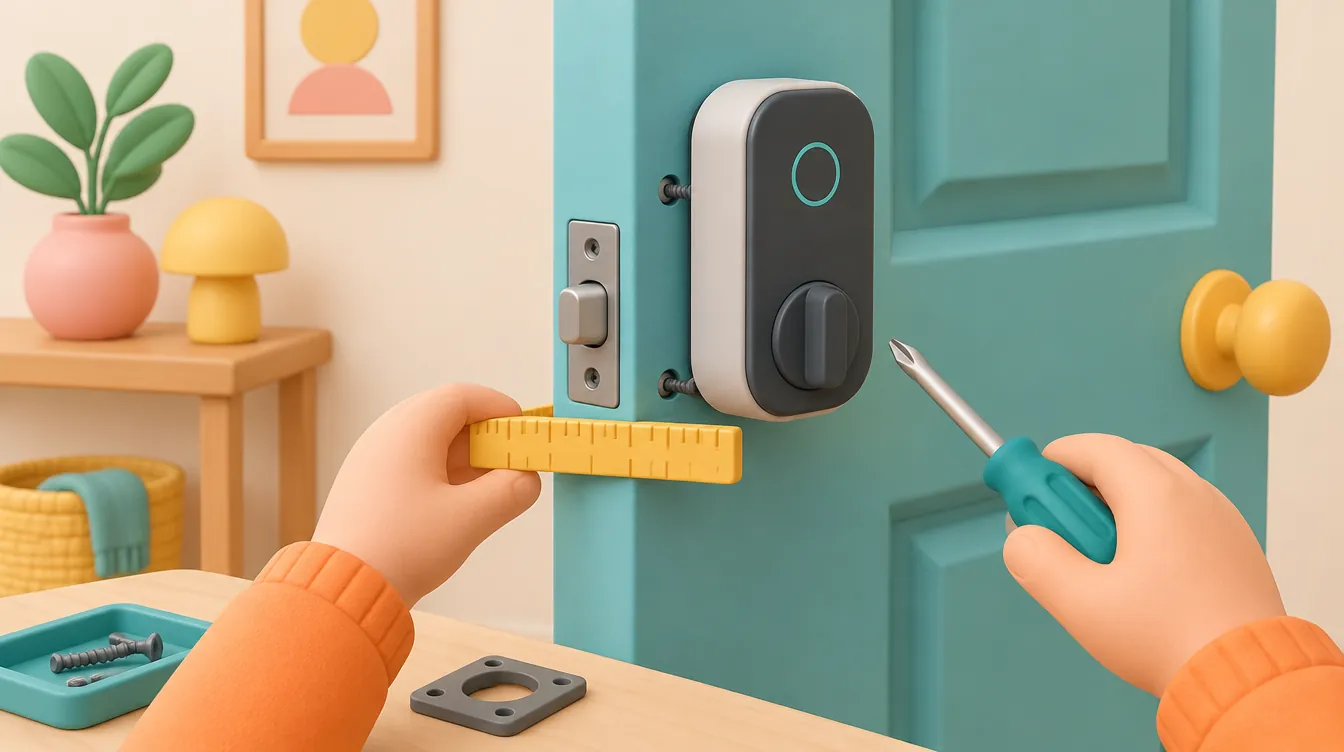
Top Pick (Full Deadbolt Replacement): Schlage Encode Smart WiFi Deadbolt (BE489WB V CAM 619) — ANSI/BHMA Grade 1 security, built-in Wi-Fi, and clean compatibility with standard 1-3/8" to 1-3/4" doors, 2-3/8" or 2-3/4" backsets, and both 2-1/8" and 1-1/2" cross bores.
Runner-Up (Renter-Safe Retrofit): August Wi-Fi Smart Lock 4th Gen (AUG-SL05-M01-S01) — Replaces only the interior thumbturn while keeping your exterior deadbolt cylinder and existing keys intact, provided your existing single-cylinder deadbolt sits on August's verified compatibility list.
Who Should Buy It: Homeowners with a clean, single-cylinder deadbolt prep whose bolt slides into the jamb pocket without rubbing, plus renters with landlord approval who need a reversible interior retrofit.
Who Should Skip It: Anyone whose door requires lifting or shoulder pressure to engage the bolt, and properties using integrated mortise cassettes, vertical-rod rim locks, or double-cylinder deadbolts without prior locksmith modification.
Top Smart Locks Compared by Door Fit & Hardware Specs
| Product & Model Number | Installation Type | Door Thickness & Backset | Cross Bore, Edge Bore & Material | Best Use Case | Retailer & Price CTA |
|---|---|---|---|---|---|
Schlage Encode Smart WiFi Deadbolt (BE489WB V CAM 619) |
Full replacement deadbolt | 1-3/8"–1-3/4" thick; 2-3/8" or 2-3/4" backset | 2-1/8" or 1-1/2" cross bore; 1" edge bore; Grade 1 zinc alloy | Best overall full replacement with keypad & Wi-Fi | Best Buy — $249.99 Target Deal vs. $299.99 MSRP |
August Wi-Fi Smart Lock 4th Gen (AUG-SL05-M01-S01) |
Interior thumbturn retrofit | Retains existing deadbolt (1-3/8"–2-1/4" typical); matches existing backset | Attaches over existing 2-1/8" or 1-1/2" prep; anodized aluminum & polycarbonate | Best for renters & HOAs keeping exterior brass/keyway | Check Live Price on Amazon |
Yale Assure Lock 2 Key-Free Wi-Fi (YRD420-WF1-BSP) |
Full replacement deadbolt (key-free) | 1-3/8"–2-1/4" thick (standard 1-3/8"–1-3/4"); 2-3/8" or 2-3/4" backset | 2-1/8" cross bore (1-1/2" without collar); 1" edge bore; Grade 2 zinc die-cast | Best key-free touchscreen for modern doors | Best Buy — $219.99 Target Deal vs. $259.99 MSRP |
Kwikset Halo Touchscreen Wi-Fi (99390-001) |
Full replacement deadbolt | 1-3/8"–2" thick (standard prep 1-3/8"–1-3/4"); 2-3/8" or 2-3/4" backset | 2-1/8" cross bore (1-1/2" adapter ready); 1" edge bore; SmartKey cylinder | Best for re-keying to match existing Kwikset knobs | Walmart — $199.00 Target Deal vs. $249.00 MSRP |
Level Bolt Smart Lock (B-BLT-U-01) |
Concealed internal deadbolt retrofit | 1-3/4"–2" standard (1-3/8" with spacer); 2-3/8" or 2-3/4" backset | Fits inside 2-1/8" cross bore & 1" edge bore; hardened stainless steel gearbox | Best invisible smart lock preserving antique trim | Check Live Price on Amazon |
Interactive Smart Lock Door Compatibility & Total Cost Checker
Enter your door dimensions, lock type, and alignment behavior to verify whether you need a retrofit unit, a full replacement deadbolt, or pre-installation carpentry.
Core Compatibility Rules: Retrofit vs. Full Replacement
Buying a smart lock based solely on Wi-Fi support, Apple HomeKit integration, or keypad aesthetics is the fastest way to end up with a half-installed lock and a deadbolted door that will not close. Smart lock door compatibility depends on physical lock architecture first and mobile ecosystem second. Before comparing app features, finishes, or Home Depot offers, establish whether your door needs an interior retrofit mechanism or a full deadbolt replacement.
As detailed in August's retrofit installation guide, a retrofit smart lock attaches exclusively to the interior side of the door while retaining your existing exterior cylinder, faceplate, and latch bolt. You unscrew the interior thumbturn, mount the motorized housing onto the existing mounting plate using brand-specific tailpiece adapters, and keep your original physical keys. However, "retrofit" does not mean universal fit. August explicitly requires a compatible existing single-cylinder deadbolt. Double-cylinder deadbolts (keyed on both sides), mortise locks with integrated lever handles, rim-mounted night latches, and interconnected locks where twisting the interior knob simultaneously retracts the deadbolt will not accept a standard thumbturn retrofit.
A full replacement smart lock—such as the Schlage Encode, Yale Assure Lock 2, or Kwikset Halo—replaces the entire deadbolt assembly: exterior keypad, interior battery housing, mounting plate, latch bolt, and strike plate. Because you are swapping the mechanical core, you must verify every structural dimension of the door prep before purchasing. Schlage's Encode door preparation guide demonstrates why a quick glance at door thickness is insufficient: its pre-install checklist verifies door thickness, backset, cross bore and edge bore hole sizes, and door jamb strike pocket depth. Each manufacturer's internal gearbox, spindle collar, and bolt throw geometry differs slightly, so always verify your tape-measure numbers against the exact model's prep diagram rather than assuming two deadbolts share identical tolerances.
Start every evaluation with a smartphone camera and a steel tape measure:
- Photograph three angles: Take clear photos of the exterior lock face, the interior lock face (including nearby trim or glass sidelights), and the edge of the door where the latch bolt emerges.
- Identify the incumbent brand and model: Check the latch faceplate on the door edge and the exterior keyway cylinder for stamped logos such as Schlage, Kwikset, Baldwin, Weiser, or Corbin Russwin. Feed those details directly into the manufacturer's official compatibility checker or support desk rather than relying on a marketplace thumbnail.
- Measure interior clearance: Even if the bores match, wide interior escutcheons (typically 2.75" to 3.25" wide and 5" to 7" tall) can collide with raised decorative door molding, storm door handles, or deadbolt-to-knob center spacing tighter than 4" to 5-1/2".
- Verify property rules: If you live in a rental apartment or an HOA-governed condominium with uniform exterior brass policies, obtain written approval before changing exterior hardware, and bag every removed screw, tailpiece, and strike plate for future move-out restoration.
| Compatibility Check | Exact Information to Collect | Resulting Purchase Decision |
|---|---|---|
| Existing Lock Hardware | Brand stamp on latch plate, single vs. double cylinder, mortise vs. tubular bore | Determines whether an August-style retrofit is mechanically viable |
| Door Preparation Specs | Door thickness, backset (2-3/8" or 2-3/4"), cross bore diameter, edge bore diameter | Confirms full replacement fit or reveals need for thick-door/adapter kits |
| Interior & Jamb Space | Distance to lower handle, raised trim clearance, 1" minimum jamb strike pocket depth | Prevents escutcheon collision and motor stall on shallow jamb pockets |
| Total Installed Cost | Device street price + adapter kits + locksmith drilling/re-aligning labor | Lets you compare true installed value instead of bare unit discounts |
How We Evaluated & Tested Compatibility Thresholds
To separate cleanly engineered smart locks from hardware that causes endless jamb friction and battery failures, we evaluated leading models against the exact dimensional standards published in ANSI/BHMA A156.36 (bored deadbolts) and manufacturer door-prep schematics from Schlage and August.
Dimensional Tolerances & Bore Flexibility: Standard modern North American exterior doors measure 1-3/8" to 1-3/4" (35 mm to 44 mm) thick, use a 2-3/8" or 2-3/4" (60 mm or 70 mm) backset (measured from the edge of the door to the center of the face hole), have a 2-1/8" (54 mm) cross bore face hole, and feature a 1" (25 mm) edge bore. However, millions of pre-1980 doors have 1-1/2" (38 mm) cross bores, and custom entry doors frequently reach 1-7/8" to 2-1/4". We penalized models locked exclusively to 2-1/8" bores when no adapter option exists, and flagged concealed units like the Level Bolt that demand strict 2-1/8" bore cavities and 1-3/4" door thicknesses for full faceplate flushness.
Jamb Depth & Motor Stall Thresholds: A full-throw deadbolt extends 1" (25 mm) past the door edge. As Schlage's Encode prep sheet highlights, the mortised pocket inside the door jamb must be at least 1" deep with a clean 1" x 2-1/4" strike footprint. Even a 1/16" misalignment between the bolt and strike lip forces an electric gearbox to draw peak current before triggering a jam error, slashing AA battery life from six months to under three weeks. Never buy a motorized lock assuming its servo motor will "force" a warped door shut. Fix hinge sag, weatherstripping compression, or strike plate position first.
Security Grade & Build Materials: We prioritized ANSI/BHMA Grade 1 or Grade 2 certified deadbolts built with solid zinc die-cast housings, hardened steel anti-saw bolt pins, and metal mounting backplates over unrated white-label locks built with thin stamped brackets and plastic gear trains.
In-Depth Product Reviews: Best Smart Locks by Door Fit
1. Schlage Encode Smart WiFi Deadbolt (BE489WB V CAM 619) — Best Overall Full Replacement
The Schlage Encode Smart WiFi Deadbolt (BE489WB V CAM 619 in Satin Nickel Camelot trim, also available in Century trim) sets the benchmark for straightforward residential door compatibility combined with top-tier mechanical security. Certified ANSI/BHMA Grade 1 AAA—the highest residential durability, finish, and security rating—it replaces your entire existing deadbolt without requiring a separate plug-in Wi-Fi bridge.
Out of the box, the Encode matches the exact parameters laid out in Schlage's Encode door preparation guide: it fits 1-3/8" to 1-3/4" doors, adjusts cleanly between 2-3/8" and 2-3/4" backsets via a rotating cam latch, and works in 1" edge bores. Crucially for owners of older homes, the Encode supports both 2-1/8" and 1-1/2" cross bores simply by snapping off the circular plastic spacer collar on the rear of the exterior touchscreen. Its capacitive touchscreen stores up to 100 customizable user codes, pairs with four standard AA alkaline batteries (lasting roughly six months under normal Wi-Fi polling), and includes a physical SC4/SC1-compatible Schlage C-keyway backup cylinder.
Dimensions & Build: The exterior touchscreen measures 3.0" wide x 5.0" high x 0.9" deep, while the interior battery assembly spans 3.0" x 5.5" x 2.2". Its zinc-alloy exterior housing and hardened steel 1/2"-throw-rated deadbolt (full 1" projection into the frame) feel substantially heavier and tighter than budget keypad locks.
Honest Flaws & Dealbreakers: If your door exceeds 1-3/4" in thickness, the Encode does not include a thick-door kit in the box, requiring a separate Schlage thick-door kit for 1-7/8" to 2-1/4" slabs. The 5.5"-tall interior housing also needs adequate vertical clearance if a decorative window frame sits directly above the deadbolt, and built-in Wi-Fi draws more standby power than Thread or Zigbee locks when signal strength at the front door drops below -70 dBm.
2. August Wi-Fi Smart Lock 4th Gen (AUG-SL05-M01-S01) — Best Renter-Safe Retrofit
When lease agreements, historic preservation rules, or HOA guidelines forbid altering your door's exterior appearance, the August Wi-Fi Smart Lock (4th Generation) (AUG-SL05-M01-S01) solves the compatibility puzzle by staying completely invisible from the street. True to August's retrofit documentation, you leave your exterior cylinder, brass escutcheon, and deadbolt latch untouched, replacing only the interior thumbturn with a compact anodized aluminum and polycarbonate cylinder.
Installation takes roughly 15 minutes with a Phillips screwdriver once you verify your existing single-cylinder deadbolt (such as most standard Schlage, Kwikset, Baldwin, or Weiser models) against August's adapter chart. Three color-coded tailpiece adapters bridge different flat, cross, or D-shaped deadbolt spindles, while wing clamps grip the existing mounting plate screws. Because it retains the original exterior keyway, roommates, landlords, and maintenance crews continue using their existing metal keys without re-keying. August also bundles its DoorSense magnetic sensor, which mounts flush or surface-mounted on the jamb to confirm whether the door is physically closed—not merely whether the deadbolt motor rotated.
Dimensions & Build: At 2.8" in diameter and 1.8" deep (weighing roughly 10.6 oz), the 4th-Gen module is 45% smaller in volume than the 3rd-Gen Pro, helping it clear tight storm-door handles and decorative door molding. Built-in 2.4 GHz Wi-Fi and Bluetooth eliminate the external August Connect wall plug.
Honest Flaws & Dealbreakers: Power comes from two CR123A lithium batteries rather than standard AAs, and frequent Wi-Fi auto-unlock events can drain a pair in 2 to 3 months ($6–$10 per swap unless you use rechargeable CR123s or add a separate bridge/Matter link). More importantly, it cannot fix a misdrilled bore or a sticky latch: any resistance in your existing deadbolt forces the compact motor to slip or throw false jam alerts, and it offers no keypad out of the box (the August Smart Keypad adds roughly $60).
3. Yale Assure Lock 2 Key-Free Touchscreen with Wi-Fi (YRD420-WF1-BSP) — Best Key-Free Replacement
For homeowners who want to eliminate physical keys entirely—eliminating bump-key and lock-picking vulnerabilities—the Yale Assure Lock 2 Key-Free Touchscreen with Wi-Fi (YRD420-WF1-BSP) offers a sleek, low-profile replacement deadbolt with generous door-prep tolerance. Certified ANSI/BHMA Grade 2, its zinc die-cast exterior keypad features a crisp matte acrylic touchscreen and a 9V battery emergency jump-start terminal hidden cleanly beneath the bottom lip.
From a fit standpoint, the Assure Lock 2 handles 1-3/8" to 1-3/4" doors natively (and up to 2-1/4" using Yale's optional thick-door kit), adjusts between 2-3/8" and 2-3/4" backsets, and accommodates both 2-1/8" and 1-1/2" cross bores by removing its plastic bore adapter collar. Its compact 2.6" x 3.6" x 0.7" exterior footprint is noticeably smaller than the Schlage Encode's exterior keypad, making it easier to clear narrow glass lites or low-mounted handle rosettes. Wi-Fi connectivity runs via a removable smart module slotted above the four AA batteries, meaning you can swap protocols later without replacing the lock hardware.
Dimensions & Build: Exterior measures 2.6" W x 3.6" H x 0.7" D; interior assembly measures 2.75" W x 5.0" H x 2.0" D. Includes Yale's DoorSense magnetic closure sensor for true closed-door auto-lock verification.
Honest Flaws & Dealbreakers: Going 100% key-free means you have zero mechanical fallback if the internal gearbox fails—though the 9V bottom terminal rescues dead AA batteries. The Wi-Fi module drains four AA batteries faster than Yale's Bluetooth-only version (averaging 3 to 4 months), and the Grade 2 rating sits one tier below Schlage Encode's Grade 1 heavy-duty certification.
4. Kwikset Halo Touchscreen Wi-Fi Smart Lock (99390-001) — Best for Matching Existing Kwikset Keys
If your home already runs on Kwikset knobs, levers, or patio deadbolts—or you need a fast way to re-key a front door after contractors leave—the Kwikset Halo Touchscreen Wi-Fi Smart Lock (99390-001) lets you match your existing house key in 30 seconds without calling a locksmith. Its patented SmartKey Security cylinder lets you insert your current Kwikset KW1 key, press the included SmartKey tool, and rotate to re-key the new smart deadbolt yourself, while adding pick- and bump-resistant sidebar engineering.
In terms of physical door fit, the Halo supports 1-3/8" to 2" door thicknesses (standard 1-3/8"–1-3/4" out of the box, with 1-3/4"–2" supported via thick-door screw packs), 2-3/8" or 2-3/4" backsets via a half-turn latch adjustment, and 2-1/8" or 1-1/2" cross bores. Its tapered deadbolt head is slightly more forgiving on minor seasonal wood swell than square-shouldered bolts, though it still demands a properly aligned 1" jamb pocket to avoid battery drain. Built-in 2.4 GHz Wi-Fi supports up to 250 user access codes without a hub.
Dimensions & Build: Exterior touchscreen measures 2.75" W x 5.59" H x 1.19" D; interior assembly measures 2.75" W x 5.75" H x 2.09" D. Rated ANSI/BHMA Grade 2 with UL 20-minute fire rating options depending on trim.
Honest Flaws & Dealbreakers: The Halo's tall 5.75" interior housing requires extra vertical clearance above your lower door handle; doors with tight 4" center-to-center spacing or large lower rosette plates can crowd the bottom battery cover screw. It also lacks Apple HomeKit support, and its glossy capacitive screen shows fingerprints more readily than the matte Yale touchscreen.
5. Level Bolt Smart Lock (B-BLT-U-01) — Best Concealed Internal Retrofit
If your entryway features custom architectural bronze, antique brass, or matching designer hardware that neither a keypad nor an interior August puck can complement, the Level Bolt (B-BLT-U-01) hides the entire motor, gearbox, and CR2 lithium battery inside the hollow cavity of the door itself. Both your exterior keyway and your interior thumbturn remain completely original.
Unlike the August 4th Gen—which attaches on top of the interior door surface—the Level Bolt replaces the internal deadbolt latch and tailpiece mechanism inside your existing 2-1/8" cross bore and 1" edge bore, fitting 2-3/8" or 2-3/4" backsets on 1-3/4" to 2" thick doors (with spacers available for 1-3/8" doors). Constructed from hardened stainless steel and alloy steel, it meets ANSI/BHMA Grade 1/A structural standards despite hiding its CR2 battery directly inside the sliding deadbolt shaft. Control runs over Bluetooth Low Energy and Apple HomeKit natively.
Dimensions & Build: Internal assembly fits strictly inside a 2-1/8" (54 mm) cross bore and 1" (25 mm) edge bore with a 1" x 2-1/4" latch faceplate. Powered by a single CR2 3V lithium battery housed inside the bolt tip.
Honest Flaws & Dealbreakers: Level Bolt has the strictest door-prep envelope on this list. It will not fit 1-1/2" cross bores, hollow-core doors with thin non-standard stiles, or existing deadbolts with oversized non-standard tailpieces. Out of the box, it has no Wi-Fi (requiring an Apple Home hub or separate Level Connect bridge for remote access) and no keypad unless paired with the add-on Level Keypad, pushing the complete cost significantly higher.
What to Avoid: Compatibility Traps & Fake Discount Warnings
Retail sales events—especially seasonal lock promotions you might track with a shopping checklist—frequently advertise deep markdowns on smart locks without surfacing hidden fit requirements or add-on costs. Watch out for four common money pits before clicking buy:
- Misidentifying Mortise or Interconnected Locks: Many urban apartments, historic brownstones, and modern multi-point doors use a single long metal faceplate on the edge with an integrated mortise cassette inside the door. No standard cylindrical smart lock (including Schlage Encode, Yale Assure 2, or August 4th Gen) drops into a mortise pocket without extensive carpentry, filler plates, or specialized mortise smart locks costing $400+.
- Ignoring 1-1/2" Legacy Cross Bores: Older wooden doors often have narrow 1-1/2" face holes instead of today's 2-1/8" standard. Buying a Level Bolt or a budget generic smart deadbolt engineered solely for 2-1/8" bores leaves you paying a locksmith $85–$150 to clamp a hole-saw jig and re-bore the door—or splitting the stile if the wood is dry.
- Buying "Smart" Locks Without Built-In Bridges: Some heavily discounted $119–$149 smart locks ship with Bluetooth only, requiring a $60–$80 proprietary Wi-Fi bridge or separate keypad to unlock remotely or hand out PIN codes. Always compare the total installed package price—including bridges, thick-door kits, and $120–$200 locksmith labor if needed—against all-in-one Wi-Fi models like the Schlage Encode or Kwikset Halo.
- Automating a Misaligned Door: If you currently push the door tightly against the weatherstripping or lift the handle upward to throw the deadbolt, a smart lock will fail within days. Motorized deadbolts have strict torque cutoffs to prevent burning out plastic or brass gears. Correct the door sag or file the strike lip before buying any automation hardware.
Frequently Asked Questions
Does retrofit mean a smart lock fits every deadbolt?
No: the retrofit design describes how a product attaches, not universal compatibility with existing hardware. August requires a compatible single-cylinder deadbolt for its approach, leaving out double-cylinder deadbolts, mortise locks, and interconnected handle sets. Identify the installed lock using photos and edge markings, and confirm the combination with its manufacturer before buying, especially when the hardware lacks an obvious model label.
Which measurements should I take for a replacement lock?
Use the exact model's preparation guide to determine the required measurements before ordering. Schlage's Encode guide checks door thickness (typically 1-3/8" to 1-3/4"), backset (2-3/8" or 2-3/4"), cross bore and edge bore hole sizes, and the door jamb strike pocket depth. Record every measurement alongside the model number and ask manufacturer support about any mismatch before assuming an adapter or minor adjustment will solve the problem.
Should I choose a lock before booking an installer?
You can shortlist one or two target models first, but resolve any uncertain door fit with the installer before placing a final order. Send clear photos of both sides of the door, your measurements, and the manufacturer's installation manual to the locksmith or handyman. Ask which extra parts—such as thick-door kits, wrap-around reinforcement plates, or jamb strike chiseling—are included in the quote so a discounted device price can be compared fairly against the complete installed cost.