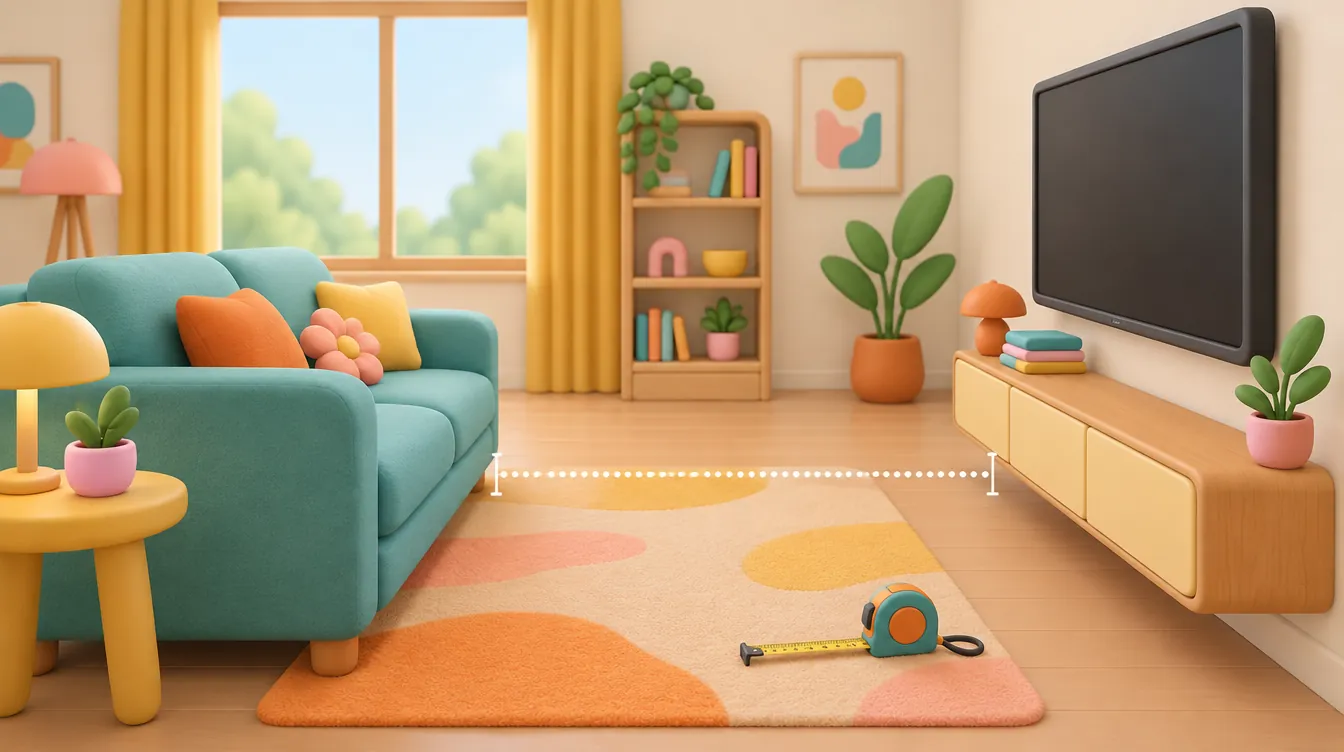
Top Pick (65-Inch All-Purpose): LG C4 65-Inch OLED (OLED65C4PUA) — At 6.5 to 9 feet, a 65-inch screen hits the sweet spot between a 40° cinema view and a 30° mixed-use field of view, and the C4 delivers per-pixel contrast, wide off-axis viewing angles, and four 48Gbps HDMI 2.1 ports without overtaking standard living-room consoles.
Runner-Up (75-Inch Large-Room Value): Hisense U8N 75-Inch Mini-LED (75U8N) — If your sofa sits 9.5 to 11 feet from the screen, stepping up to 75 inches adds 33% more picture area (2,407 vs. 1,809 square inches), and the 75-inch U8N pairs high Mini-LED brightness with an ADS Pro panel for wider sofa seating angles.
Who Should Buy This Guide's Picks: Shoppers measuring 6 to 11.5 feet from eye to screen who want to match their exact room dimensions, seating layout, and ambient light before committing to a 55-, 65-, 75-, or 85-inch panel.
Who Should Skip Upsizing: Anyone whose seating sits closer than 6 feet, whose wall or console cannot accommodate a 65.4-inch-wide 75-inch panel, or anyone tempted to trade an OLED or well-dimmed 65-inch Mini-LED for an edge-lit 75-inch budget TV just for a bigger holiday discount badge.
Top 4K TV Picks by Viewing Distance and Size Tier
| Model & Exact SKU | Size & Screen Width | 3 Key Hardware Specs | Best Use Case | Retailer & Price CTA |
|---|---|---|---|---|
LG C4 65-Inch OLED (OLED65C4PUA) |
65 in (56.7 in image width) | WRGB WOLED self-lit panel; 144Hz native refresh rate; 4x HDMI 2.1 (48Gbps) & VESA 300x200 | 6.5–9 ft mixed & dark-room movie viewing | Check Live Price on Amazon |
Hisense U8N 75-Inch Mini-LED (75U8N) |
75 in (65.4 in image width) | 75-in ADS Pro Mini-LED panel; 2,000+ dimming zones; 144Hz & VESA 600x400 | 9.5–11 ft bright family rooms & wide sofas | $1,399 target deal ($1,999 MSRP) at Best Buy |
TCL QM7 65-Inch QD-Mini LED (65QM751G) |
65 in (56.7 in image width) | High-contrast VA QLED Mini-LED; 120Hz/144Hz VRR; 2x HDMI 2.1 & VESA 300x300 | 7–9 ft budget-conscious HDR & gaming rooms | Check Live Price on Amazon |
Samsung S90D 55-Inch OLED (QN55S90DAFXZA) |
55 in (47.9 in image width) | QD-OLED panel (55–77 in US); 144Hz VRR; 4x HDMI 2.1 & VESA 300x200 | 5.5–7.5 ft bedrooms, dens & close sofas | $1,299 target deal ($1,999 MSRP) at Walmart |
Sony BRAVIA 7 85-Inch Mini-LED (K-85XR70) |
85 in (74.1 in image width) | VA Mini-LED with XR Backlight Master Drive; 120Hz; 2x HDMI 2.1 & VESA 400x400 | 9.5–11.5 ft dedicated walls & long living rooms | $2,498 target deal ($3,499 MSRP) at B&H |
Interactive TV Size, Viewing Distance & Wall Fit Calculator
Enter your eye-to-screen seating distance, preferred field of view, and available wall or console width below. The calculator applies the horizontal field-of-view equation derived from RTINGS' 16:9 screen widths (distance = screen width ÷ [2 × tan(angle ÷ 2)]) and checks Sony's 1.5× screen-height 4K detail baseline alongside physical clearance.
Measure from your seated eye position to the front surface of the screen (not the back wall if using a stand).
| TV Size | 16:9 Image (W × H) | Screen Area | FOV at Your Seat | Sony 1.5×H 4K Min | Wall Fit Status |
|---|
Core Buying Rules: Viewing Distance, 4K Resolution, and Real Dimensions
Choosing the right TV size starts with measuring from your primary seated eye position to the front face of the proposed screen—not from the sofa backrest to the drywall. A 65-inch 4K television fits most living rooms cleanly, while a sofa positioned 9 to 10 feet away often benefits from a 75-inch screen if your budget does not force a steep downgrade in panel quality. Contrary to seasonal sales hype, there is no universal "75-inch holiday sweet spot." Physical room clearance, off-axis seating geometry, panel contrast, and the actual delivered price determine which size earns its keep.
According to RTINGS' size-to-distance methodology, a television should occupy roughly 30° of your horizontal field of view for mixed daily watching (news, sports, sitcoms, and daytime broadcasts) and around 40° for an immersive, theater-style movie experience. Those numbers are practical comfort baselines rather than rigid architectural limits. Using RTINGS' published 16:9 active image widths and the trigonometric formula distance = screen width ÷ [2 × tan(desired horizontal angle ÷ 2)], we derived the rounded seating guide below:
| TV Diagonal Size | Approx. 16:9 Screen Width | Approx. 16:9 Screen Height | Screen Area | Immersive 40° Seat | Mixed-Use 30° Seat | Typical Room Decision |
|---|---|---|---|---|---|---|
| 55 inches | 47.9 in | 27.0 in | 1,293 sq in | 5.5 ft | 7.5 ft | Bedrooms, apartments, or close primary sofas |
| 65 inches | 56.7 in | 31.9 in | 1,809 sq in | 6.5 ft | 9.0 ft | Versatile living-room default |
| 75 inches | 65.4 in | 36.8 in | 2,407 sq in | 7.5 ft | 10.0 ft | Deeper sofas prioritizing cinema scale |
| 85 inches | 74.1 in | 41.7 in | 3,090 sq in | 8.5 ft | 11.5 ft | Dedicated media walls and large open rooms |
(Note: All screen dimensions above reflect active 16:9 picture dimensions before adding bezel thickness, bottom chin, or stand hardware. Distances are derived from RTINGS' 16:9 widths and 30°–40° angle guidance, rounded to the nearest half foot for real-world room layout.)
Does 4K Mean You Should Sit Four Feet Away?
Shoppers frequently confuse two different distance rules. Sony's official 4K viewing-distance guidance calculates distance at approximately 1.5 times screen height: roughly 3.94 feet for a 65-inch TV and 4.59 feet for a 75-inch TV. That table answers a narrow optical question—how close you can sit before individual 4K pixels stop blending into a continuous image. It is not a comfortable daily seating recommendation. Sitting 4 feet from a 65-inch panel pushes your horizontal field of view past 58°, forcing constant head movement during sports or subtitles.
At ordinary living-room distances, pixel visibility is rarely the limiting factor. RTINGS notes that discerning 4K detail over 1080p on a 65-inch screen tapers off beyond roughly 8.5 feet depending on visual acuity and source bitrate. Farther out, immersion and perceived scale dominate—though blowing up a low-bitrate cable feed or heavily compressed 720p sports stream onto a 75- or 85-inch display also magnifies macroblocking and compression artifacts. Do not pay a steep premium for an 8K television solely because you are stepping up to 85 inches; native 8K content remains scarce, and a top-tier 4K OLED or Mini-LED panel with superior contrast and upscaling outperforms a compromised 8K LCD at normal seating distances.
How to Measure the Room, Stand, and Delivery Path
Before buying, grab painter's tape and map the exact screen rectangle onto your wall. Because a 75-inch 16:9 image measures roughly 65.4 by 36.8 inches versus 56.7 by 31.9 inches for a 65-inch screen, the 75-inch jump adds 8.7 inches of width, 4.9 inches of height, and roughly 33% more total picture area (2,407 vs. 1,809 square inches). That extra width easily crosses a bookcase molding, blocks a light switch, or overhangs a 60-inch media console.
If you plan to use the included tabletop feet rather than a wall bracket, check the center-to-center distance between stand legs, not just the panel's outer width. Many 75- and 85-inch sets use wide-stance blade feet spaced 50 to 62 inches apart, requiring a deep, wide credenza unless the model includes narrow inner-mount holes or a central pedestal. If wall-mounting, verify the VESA bolt pattern (typically 300×200 mm or 300×300 mm on 65-inch TVs, jumping to 400×400 mm or 600×400 mm on 75- and 85-inch sets), stud spacing, and bracket weight rating. Keep the vertical center of the screen close to seated eye level—roughly 40 to 44 inches off the floor—and avoid high fireplace mounts that strain your neck and push VA LCD panels off their vertical contrast sweet spot.
Finally, measure your delivery path. A 75-inch television ships in a protective carton roughly 72 inches wide, 44 inches tall, and 8 inches deep, weighing 90 to 110 pounds; an 85-inch carton routinely exceeds 80 inches in length and 125 pounds. Measure tight hallway turns, elevator doors, and stairwell landings before ordering, and keep the original box intact until you have inspected screen uniformity and cleared the retailer's return window.
The Real 65- vs. 75-Inch Trade-Off: Size vs. Panel Quality
At 8 feet, either 65 or 75 inches works depending on your preference for a relaxed living-room frame versus front-row immersion. At 10 feet, a 75-inch screen hits the 30° mixed-use baseline cleanly while 65 inches drops to around 23°. However, budget complicates that geometry. When a shopper faces a fixed $1,300 to $1,600 budget, the choice is rarely "65-inch flagship vs. 75-inch flagship." It is almost always a bigger midrange LCD versus a smaller premium OLED or high-zone Mini-LED.
If you watch cinema in a dim or dark room, a 65-inch OLED (or 77-inch OLED if your budget stretches) preserves true black levels and zero blooming around subtitles—benefits you notice on every frame. Conversely, in a sunlit family room where viewers sit 10 feet back on a sectional sofa, the extra 33% surface area and higher peak luminance of a well-dimmed 75-inch Mini-LED TV often deliver a better everyday upgrade than a smaller screen.
How We Evaluated & Selected Our Picks
To separate worthwhile size upgrades from compromised big-screen bargains, we screened current 55-, 65-, 75-, and 85-inch 4K models against four objective hardware and room-fit criteria:
- Off-Axis Viewing Angles & Panel Consistency: Per RTINGS' viewing-angle testing, wide rooms with L-shaped sectionals punish standard VA LCD panels, which wash out colors and drop contrast past 20° to 25° off center. For large 75-inch living rooms, we prioritized self-lit OLEDs or ADS Pro / wide-angle Mini-LED designs unless the buyer sits mostly centered. We also flagged series where manufacturers swap panel types across sizes (such as 75-inch models using ADS Pro while 65- and 85-inch siblings use VA).
- Contrast & Local Dimming Thresholds: Stepping up to 75 or 85 inches stretches backlight hardware over a massive surface area. We eliminated edge-lit and low-zone direct-lit LCDs that turn dark letterbox bars gray, requiring either self-emissive OLED pixels or true full-array Mini-LED local dimming (typically 500+ zones on 65-inch sets and 1,000+ zones on 75- and 85-inch sets).
- Physical Footprint, VESA Standards, & Console Compatibility: We verified exact external dimensions with and without stands, stand-foot widths, VESA mounting geometry, and anti-reflection handling for bright rooms.
- Gaming & Future-Proof Connectivity: Every pick below includes at least two full-bandwidth HDMI 2.1 ports (48Gbps or 40Gbps) supporting 4K at 120Hz or 144Hz with Variable Refresh Rate (VRR) and Auto Low Latency Mode (ALLM), ensuring a large living-room screen does not bottleneck current consoles or PCs.
In-Depth Individual TV Reviews by Size Tier
1. LG C4 65-Inch OLED (OLED65C4PUA) — Best 65-Inch All-Purpose TV
For living rooms where your sofa sits 6.5 to 9 feet from the screen, the LG C4 65-inch OLED (OLED65C4PUA) hits the highest overall balance of picture accuracy, gaming responsiveness, and compact furniture fit. Its 65-inch WRGB OLED panel produces 100% per-pixel local dimming—turning off individual pixels completely for infinite contrast—which eliminates the haloing and cloudy blacks that distract viewers on budget LCDs during dark sci-fi or evening drama viewing. At 56.7 inches of active width (56.7 inches wide total with razor-thin 0.2-inch borders, 32.5 inches tall without stand, and 1.8 inches deep at the lower electronics housing), it easily anchors a 60-inch media console.
LG's slim central brushed-metal pedestal stand measures just 18.5 inches wide by 9.1 inches deep, making the OLED65C4PUA far easier to place on narrow furniture than dual-leg TVs whose feet span 50 inches. Connectivity is class-leading: all four HDMI ports support full 48Gbps HDMI 2.1 up to 4K 144Hz with G-Sync, FreeSync Premium, and Dolby Vision gaming, alongside a standard 300×200 mm VESA mount pattern (weighing 36.6 pounds without stand). Off-axis viewing angles remain virtually distortion-free past 70°, so viewers seated at the far edges of a sectional see accurate saturation.
Honest Flaws & Dealbreakers: While the C4 improved sustained HDR brightness over earlier C-series models (reaching roughly 950–1,000 nits in small highlights), its glossy screen lacks the specialized anti-glare layer of the pricier LG G4 or matte Samsung S95D, so direct afternoon sunlight from opposite windows creates mirror-like reflections. It also lacks an ATSC 3.0 NextGen TV tuner. And if your sofa sits 10.5 feet away, a 65-inch panel drops below the 30° mixed-use threshold—though upgrading to the 77-inch LG C4 (OLED77C4PUA, 67.1 inches wide) solves that if your budget allows.
2. Hisense U8N 75-Inch Mini-LED (75U8N) — Best 75-Inch Value for Bright Rooms & Wide Sofas
When your seating distance measures 9.5 to 11 feet and you want the extra 33% area of a 75-inch panel without paying OLED flagship prices, the Hisense U8N 75-inch Mini-LED (75U8N) is uniquely suited to real family-room geometry. Critically, unlike the 55-, 65-, and 85-inch sizes in the U8N lineup that use high-contrast VA panels, Hisense builds the 75-inch 75U8N with an ADS Pro (IPS-type) Mini-LED panel paired with over 2,000 local dimming zones. That hardware twist directly solves one of the biggest headaches of buying a 75-inch LCD: wide sectional sofas no longer suffer severe color washout at 30° to 45° off center.
Measuring 65.9 inches wide by 37.9 inches tall (3.0 inches deep) without its stand and weighing 80.5 pounds before mounting (VESA 600×400 mm), the 75U8N pairs substantial chassis rigidity with a sleek central pedestal stand (roughly 17.7 inches wide) that fits standard 55- to 65-inch consoles despite its massive screen span. Real-world HDR highlights push past 2,500 nits in small windows while full-screen brightness easily overpowers sunlit living rooms. It also ships with an ATSC 3.0 tuner, Google TV, and two 4K 144Hz HDMI 2.1 ports (one doubles as eARC, leaving one dedicated HDMI 2.1 input if you connect a soundbar via eARC).
Honest Flaws & Dealbreakers: Because ADS Pro panels have lower native static contrast (1,500:1) than VA panels (5,000:1+), the 75U8N relies heavily on its 2,000+ Mini-LED dimming zones to stay dark. In pitch-black rooms, subtle haloing can appear around bright white credits or starfields compared to an OLED, and its motion upscaling on noisy 720p sports lags slightly behind Sony's XR processing. Additionally, its heavy 98-pound boxed weight makes two-person delivery and stair clearance mandatory.
3. TCL QM7 65-Inch QD-Mini LED (65QM751G) — Best Budget-Friendly 65-Inch Performance Pick
If you sit 7 to 9 feet away and want true Mini-LED local dimming without spending four figures on an OLED, the TCL QM7 65-inch (65QM751G) exposes why buying a smaller, better-built 65-inch set beats stretching your budget into a dim, edge-lit 75-inch entry model. Built around a high-contrast VA QLED panel backed by over 1,000 Mini-LED zones (around 1,500+ in larger sizes), the 65QM751G achieves deep native blacks, punchy HDR highlights exceeding 1,500–2,000 nits, and minimal blooming when viewed from centered seats.
Physically, the 65-inch QM7 measures 56.9 inches wide by 32.8 inches tall (2.2 inches deep) and weighs 41.2 pounds without its stand, mounting via a standard 300×300 mm VESA pattern. Its central metal pedestal base keeps the footprint compact enough for 48-inch consoles while maintaining enough clearance underneath (roughly 2.6 inches) for slim soundbars. Gamers get two HDMI 2.1 ports supporting 4K 120Hz (and up to 144Hz VRR on PC), low input lag (~13ms at 60Hz, ~6ms at 120Hz), and responsive Google TV navigation.
Honest Flaws & Dealbreakers: Its VA panel is a double-edged sword for room layout. Directly in front of the screen, contrast is terrific; move 30° off-axis to the far corner of a loveseat, and blacks visibly lighten while skin tones desaturate. Its anti-reflective coating is also average, producing streaks under direct lamps, and like the Hisense, one of its two HDMI 2.1 ports handles eARC—meaning soundbar owners only have one free HDMI 2.1 port for a PS5 or Xbox Series X.
4. Samsung S90D 55-Inch OLED (QN55S90DAFXZA) — Best 55-Inch Pick for Close Seating & Dens
At seating distances between 5.5 and 7.5 feet—typical of bedrooms, home offices, and compact apartments—a 65-inch screen can overwhelm peripheral vision during fast-paced broadcasts, while a 55-inch screen hits the 30°–40° zone cleanly. In the North American market, the Samsung S90D 55-inch (QN55S90DAFXZA) uses a QD-OLED panel (note: in the U.S., the 55-, 65-, and 77-inch S90D sizes are QD-OLED, whereas the 42-, 48-, and 83-inch versions use WOLED). QD-OLED replaces white subpixels with pure red, green, and blue quantum-dot layers, yielding richer color volume in bright HDR highlights and virtually flawless viewing angles from any chair in the room.
Measuring just 48.2 inches wide by 27.9 inches tall and a razor-thin 1.6 inches deep at its thickest lower section (32.2 pounds without stand; VESA 300×200 mm), the 55-inch S90D tucks neatly onto small 40-inch dressers via its narrow central Blade stand. All four HDMI ports run full 40–48Gbps HDMI 2.1 bandwidth at up to 4K 144Hz, making it a stellar companion for high-refresh PC gaming or dual-console setups.
Honest Flaws & Dealbreakers: Samsung still refuses to license Dolby Vision HDR, relying instead on HDR10 and HDR10+, so Dolby Vision streams from Netflix or Apple TV fall back to standard HDR10 tone mapping. Its glossy screen also lifts black levels slightly to a faint purplish-gray if hit directly by bright daytime sunlight. If your seating pushes past 8 feet, skip the 55-inch size and step up to the 65-inch S90D (QN65S90DAFXZA).
5. Sony BRAVIA 7 85-Inch Mini-LED (K-85XR70) — Best 85-Inch Pick for Large Walls & Long Rooms
When your sofa sits 9.5 to 11.5 feet away and your living room has an uninterrupted wall over 80 inches wide, an 85-inch screen transforms sports and cinema into a true home-theater anchor. The Sony BRAVIA 7 85-inch (K-85XR70) uses a high-contrast VA panel driven by Sony's XR Backlight Master Drive Mini-LED architecture and XR Processor. Where oversized budget 85-inch sets stumble—turning compressed 720p broadcasts and 1080p streams into blotchy messes across 3,090 square inches of screen—Sony's upscaling and gradient smoothing keep low-bitrate cable feeds remarkably clean.
The K-85XR70 measures 74.4 inches wide by 42.6 inches tall (2.2 inches deep) and tips the scales at 105.6 pounds without its stand (VESA 400×400 mm). Its clever four-way aluminum blade feet can be installed at a wide 60.5-inch stance or a narrow 25.7-inch inner stance, and at two different vertical heights—a lifesaver if you want to raise the screen 2.5 inches to clear a Sonos Arc or similar tall soundbar. It delivers over 2,000 nits of peak HDR luminance and includes an ATSC 3.0 tuner.
Honest Flaws & Dealbreakers: Only two of the four HDMI inputs support HDMI 2.1 (4K 120Hz), and one of those doubles as the eARC audio port. More importantly for wide living rooms, the K-85XR70 lacks Sony's X-Wide Angle optical layer (found on the pricier BRAVIA 9), so off-axis color saturation drops noticeably past 25° off center, and its glossy panel reflects facing windows. Finally, verify your stairwells: its shipping carton spans roughly 79 × 48 × 9 inches and weighs nearly 140 pounds.
What to Avoid: Holiday Discount Traps, Panel Swaps, and Mounting Mistakes
- The "Bigger Discount Percentage" Trap: During November sales, retailers slash $400–$600 off oversized 75- and 85-inch entry-level LCDs (like edge-lit or basic direct-lit 60Hz models with inflated MSRPs). A 75-inch TV without local dimming cannot display true shadows; dark scenes turn milky blue-gray, and fast sports smear across a massive canvas. Never trade a tested 65-inch OLED or high-zone Mini-LED for a dimmer, 60Hz 75-inch set just because the savings badge reads "45% Off."
- Assuming All Sizes in One Model Series Share the Same Panel: Manufacturers frequently mix VA and IPS/ADS panels—or even WOLED and QD-OLED—within the same product name. For instance, the 75-inch Hisense U8N uses an ADS Pro panel while its 65- and 85-inch siblings use VA; Samsung's 55-, 65-, and 77-inch S90D models use QD-OLED in North America while the 42-, 48-, and 83-inch sizes use WOLED. Always verify independent test measurements for the exact diagonal size you are ordering.
- Paying for 8K Upsells on 85-Inch Screens: Even on an 85-inch screen (74.1 inches wide) viewed at 9 to 11 feet, human vision cannot resolve native 8K pixels over 4K, and native 8K streaming remains virtually nonexistent. Put that extra budget toward a larger OLED or superior Mini-LED dimming instead.
- Fireplace Height & Narrow-Credenza Mismatches: Mounting a 75-inch TV above a tall mantel tilts your neck upward at 20°+ and throws VA LCD panels outside their ideal vertical viewing cone. Likewise, buying a wide-legged 75-inch set for a 55-inch console creates a tip hazard unless you confirm narrow inner leg positions or use a freestanding VESA pedestal.
Frequently Asked Questions (FAQs)
What size TV should I get for a 10-foot viewing distance?
For a 10-foot seating distance from your eyes to the screen, a 75-inch 16:9 TV is the most balanced starting point because its 65.4-inch width fills roughly 30° of your horizontal field of view for comfortable mixed use. If you prefer a more immersive, theater-like 35° to 40° view and have at least 80 inches of wall clearance, a 77-inch OLED or 85-inch screen works well. A 65-inch TV remains usable at 10 feet (~23° field of view), making sense only if your budget forces a choice between a compromised 75-inch budget LCD and a far higher-quality 65-inch OLED or Mini-LED.
How much bigger is a 75-inch TV than a 65-inch, and is 75 inches too big for 8 feet?
A 75-inch 16:9 image measures roughly 65.4 by 36.8 inches, compared to 56.7 by 31.9 inches on a 65-inch screen—making the 75-inch picture about 8.7 inches wider, 4.9 inches taller, and 33% larger in total screen area (2,407 vs. 1,809 square inches) before bezels or stands. At an 8-foot seating distance, a 75-inch screen fills roughly 37° of your horizontal vision, sitting cleanly inside RTINGS' 30°–40° guidance as an immersive cinema setup. Tape the 65.4 × 36.8-inch rectangle onto your wall first to ensure it fits your console width and does not overwhelm daytime viewing.
Should I choose a bigger cheap 75-inch TV or a smaller 65-inch OLED?
Your room lighting, viewing distance, and content habits decide that trade-off. If you watch movies or HDR shows in a dim room from 7 to 9 feet away, a 65-inch OLED delivers vastly better black levels, zero backlight blooming, and wide viewing angles that you notice on every scene. However, if your sofa sits 10 to 12 feet back in a bright daytime family room, sacrificing contrast for a larger 75-inch screen can be worthwhile—provided you still step up to a Mini-LED model with real local dimming rather than a dim, edge-lit bargain TV.