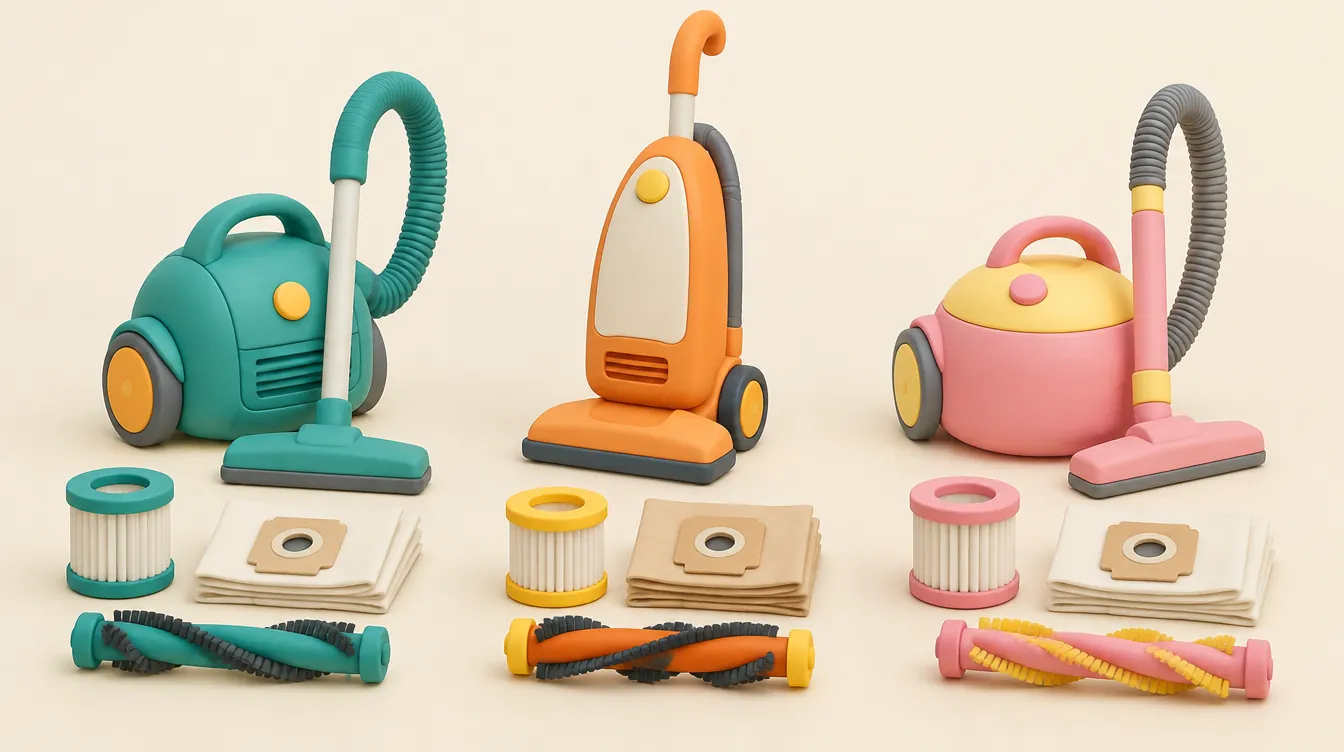
Top Pick — Dyson V15 Detect (447000-01): Uses a single rear-mounted, cold-water washable HEPA filter (#970013-02) with zero mandatory disposal bags, keeping recurring consumable spend near $0 if you can accommodate Dyson's strict 24-hour drying window.
Runner-Up — Miele Classic C1 Pure Suction (SBAF3): Eliminates filter-washing downtime entirely by bundling both the motor-protection filter and AirClean exhaust filter inside every genuine 4-pack of 4.5-liter Type GN bags.
Who Should Buy It: Shoppers who compare a vacuum's 3-year filter, bag, and roller replacement exposure alongside the upfront sale price before checking out.
Who Should Skip It: Anyone expecting a "bagless" self-emptying robot vacuum or a heavily discounted cordless bundle to operate with zero ongoing supply purchases or weekly brush upkeep.
Top 5 Vacuums Compared by Hardware Specs and Upkeep Requirements
| Vacuum Model | Exact Model # | Filtration & Bag Architecture | Weight & Capacity | Consumable Rule & Dry Time | Best Use Case | Retailer & Price |
|---|---|---|---|---|---|---|
| Dyson V15 Detect | 447000-01 (SV22) |
Single washable post-motor HEPA (970013-02), bagless cyclone |
6.8 lbs; 0.2-gal (0.76 L) polycarbonate bin | Wash monthly with cold water; 24-hr mandatory dry time | Low-consumable cordless cleaning across mixed floors | Check Live Price on Amazon |
| Miele Classic C1 Pure Suction | SBAF3 (11181020) |
Disposable HyClean 3D Type GN bag + AirClean exhaust filter | 13.0 lbs; 4.5-L (4.76-qt) self-sealing fleece bag | Non-washable bags & filters; 0-hr dry time (filters packed in bag box) | Sealed allergy control on hard floors & low-pile rugs | Best Buy — $279 target deal vs. $349 MSRP |
| iRobot Roomba j7+ | j755020 |
Dry-only pleated High-Efficiency Filter (4747486) + Clean Base bag (4640235) |
7.4 lbs robot (13.3" × 3.4"); 0.4-L bin + Clean Base dock | Never wash robot filter; replace model-specific dock bags | Hands-free daily scheduled pickup with obstacle avoidance | Check Live Price on Amazon |
| Shark Navigator Lift-Away | NV352 |
Washable foam/felt pre-motor (XFF350) + post-motor HEPA (XHF350) |
12.5 lbs; 1.2-qt ABS lift-away dust cup | Rinse foam/felt with water only; 24-hr dry time | Budget upright suction for high-pile carpet & stairs | Walmart — $149 target deal vs. $199 MSRP |
| Dyson V8 Plus | 447032-01 (SV25) |
Dual washable filters (pre-motor cone + post-motor filter), bagless | 5.6 lbs; 0.14-gal (0.54 L) bin | Wash monthly with cold water; 24-hr mandatory dry time | Lightweight cordless cleaning in apartments & small homes | Target — $329 target deal vs. $469 MSRP |
Interactive Calculator: 3-Year Vacuum Running Cost & Maintenance Estimator
Use this tool to test how filter rules, self-emptying dock bags, and spare-part backups change a vacuum's real 3-year cost before you buy. Select a model preset or enter custom consumable prices from your preferred retailer.
3-Year Vacuum Running Cost & Downtime Calculator
P229 Cost ModelThe Hidden Math of Vacuum Running Costs: Filter, Bag, and Dock Rules
A vacuum's sale tag tells you the entry fee, not the cost of keeping its airflow intact over three to five years of ownership. Before buying any cordless stick, upright, canister, or robot vacuum, build a parts list around the exact machine model number and—if it ships with one—the exact model number of its emptying dock. Searching by brand name alone causes costly mistakes because manufacturers routinely alter filter geometries and disposal bag collars between sub-series.
Start by separating cleaning instructions from replacement schedules. Manufacturers split into two distinct filtration camps: washable systems that trade cash outlay for drying downtime, and dry-only systems that trade convenience for recurring consumable purchases. According to Dyson's official cordless filter care guidance, cordless models require regular cold-water washing without detergents, followed by at least 24 hours of air-drying until the media is completely dry before refitting. Refitting a damp filter traps moisture inside the motor housing, degrades airflow, and breeds mildew odors.
By contrast, many automated and sealed vacuums prohibit washing altogether. iRobot's official filter guidance for Roomba e, i, and j series and the Combo 10 Max explicitly warns that their high-efficiency filters must not be washed or exposed to liquid. Even if the robot's plastic dustbin is rinseable, the pleated filter tucked inside that bin is dry-only. Mixing up care instructions between a Dyson stick and a Roomba robot ruins a $10 to $20 pleated filter in seconds.
Just as critical is accounting for hybrid "bagless-plus-bagged" hardware. A bagless robot vacuum still creates recurring bag expenses the moment you pair it with an automatic emptying station. iRobot's Clean Base maintenance instructions specify replacing disposal bags matched to the exact Clean Base model group—meaning bags engineered for an i-series or j-series Clean Base do not automatically fit newer docks like the Combo 10 Max AutoWash station or Essential docks.
| Component | Key Verification Question | Cost or Routine to Record Before Checkout |
|---|---|---|
| Filter(s) | Washable with water or dry-only replacement? | Drying time (often 24 hours) or unit price per genuine filter |
| Disposal Bag | Required by the vacuum or its emptying dock? | Exact part number, pack count, and price per compatible bag |
| Brush / Roller | Hair-detangling, replaceable bristles, or rubber extractors? | Cleaning steps plus replacement price when bristles or fins wear |
| Emptying Dock | Does the dock use separate bags, pads, or fluids? | Dock model number and ongoing supply availability |
If a manufacturer's manual states "replace as needed" or ties intervals to debris volume rather than a fixed calendar date, resist inventing an arbitrary replacement schedule just to force a tidy annual total. Instead, record the unit price of each consumable from a seller you actually use—and flag out-of-stock or hard-to-source parts as an unresolved buying risk before you commit.
How We Audited Maintenance Schedules, Part Compatibility, and Ownership Exposure
Because we did not conduct laboratory dust-loading tests on these machines, our evaluation focuses on auditing published manufacturer maintenance manuals, OEM part numbers, chassis materials, and real-world consumable lock-in across five popular floor-care architectures. Every model in our comparison had to satisfy four practical ownership criteria:
- Verifiable Part Numbers and Supply Continuity: Each machine's primary filter, bag, and roller must carry a distinct, publicly documented OEM SKU with multi-retailer availability—eliminating white-label vacuums that disappear after one holiday cycle.
- Clear Separation of Washable vs. Disposable Rules: We audited official care documentation to verify whether pre-motor and post-motor filters tolerate cold water, require 24-hour drying, or strictly forbid liquid exposure.
- True Bundled Value Check: When evaluating retail bundles or promotional listings (especially at big-box stores like Walmart), we strip away low-utility plastic crevice tools and count only consumable wear items—spare filters, disposal bags, and side brushes—you will genuinely use.
- Maintenance Friction vs. Household Cadence: A 24-hour drying window is painless if you vacuum twice a week, but disruptive if you clean up pet hair every evening and own only one filter. We weighed dollar savings against actual household workflow friction.
In-Depth Reviews: 5 Vacuums Evaluated by Build Specs and True Upkeep
1. Dyson V15 Detect (447000-01) — Best Low-Consumable Cordless Pick
The Dyson V15 Detect keeps ongoing vacuum running costs remarkably flat by consolidating its filtration into a single, rear-mounted washable HEPA unit (Part #970013-02). Unlike older cordless sticks with separate pre-motor cones and rear shrouds, this single twist-off assembly handles fine-particle capture behind 14 concentric cyclones generating 240 Air Watts of suction. You pay more upfront for the ABS polycarbonate chassis, piezoelectric acoustic dust sensor, and 60-minute click-in lithium battery, but you avoid buying disposal bags or monthly paper cartridges.
In day-to-day upkeep, the V15 Detect requires discipline rather than cash. Weighing 6.8 pounds with a 0.2-gallon (0.76-liter) point-and-shoot dustbin, it clears bare floors with the Fluffy Optic laser head and digs into medium-pile carpet with the detangling Digital Motorbar head. Dyson specifies washing the filter under cold tap water roughly once a month—more often if you vacuum fine drywall dust or heavy pet dander—without soap or dishwasher heat, then leaving it in a warm, ventilated spot for a minimum of 24 hours.
The Flaws and Dealbreakers: That 24-hour drying requirement sidelines your only cordless vacuum for an entire day unless you spend roughly $40 upfront on a second OEM filter to rotate in. Additionally, long-term battery aging after 3 to 5 years represents a major single-item expense (typically $130 to $150 for a genuine click-in pack), so the V15 Detect is only low-cost over time if you keep the filter spotless to prevent overheating the motor and cells.
2. Miele Classic C1 Pure Suction (SBAF3) — Runner-Up for Predictable Bagged Upkeep
If rinsing dusty foam and waiting 24 hours for filters to dry sounds miserable, the Miele Classic C1 Pure Suction turns running costs into a tidy, zero-mess subscription inside every box of bags. Built around a 1,200-watt Miele Vortex motor inside a 13-pound German-engineered ABS canister, the SBAF3 delivers a 29.5-foot operating radius and a 6-setting rotary suction dial that dials down easily for area rugs and drapes. Its 4.5-liter (4.76-quart) HyClean 3D Efficiency Type GN bag acts as the primary dust chamber, self-sealing automatically with a spring-loaded collar the moment you lift the canister lid.
What makes Miele's consumable economics unusually transparent is what sits inside a genuine 4-pack of Type GN bags (usually $22 to $25): four multi-ply fleece bags plus one pre-motor protection filter and one AirClean exhaust filter. Because the bag traps over 99.9% of dust before air ever reaches the secondary filters, you replace those two filters on the exact rhythm of finishing a box of bags—zero drying wait, zero washing, and zero surprise separate filter bills.
The Flaws and Dealbreakers: The Classic C1 Pure Suction ships with the straight-suction AllTeQ combination floorhead (SBD 285-3), which excels on hardwood, tile, and low-pile rugs but lacks an electrically powered brushroll for deep, high-pile wall-to-wall carpeting. If your home is mostly thick plush carpet, stepping up to a powerhead-equipped Miele raises both the upfront price and brushroll upkeep. Still, at its frequent $279 deal price versus its $349 MSRP, its 3-year consumable cost stays well under $110 for typical households.
3. iRobot Roomba j7+ (j755020) — Best Automated Pickup (With Two Consumable Streams)
The iRobot Roomba j7+ eliminates daily floor pushing, yet shoppers routinely underestimate its running costs because it draws from two separate consumable budgets at once. At 13.3 inches wide and 3.4 inches tall (7.4 pounds), the robot uses dual multi-surface rubber extractors and PrecisionVision front-camera navigation to steer around pet waste and charging cords while vacuuming into an onboard 0.4-liter bin. When it docks, the Clean Base Automatic Dirt Disposal tower pulls debris through a bottom port into a disposable AllergenLock bag.
Before purchasing, inspect both parts lists carefully. First, the robot's High-Efficiency Filter (Part #4747486) is strictly non-washable under iRobot's Knowledge Base rule #2449; rinsing it destroys the pleated fibers. Second, the Clean Base requires the specific AllergenLock disposal bag (#4640235) matched to i, j, and s-series Clean Base docks. Add in periodic replacements for the spinning edge-sweeping brush and rubber extractor rollers—which wear down faster on textured tile or high-pile carpet—and a multi-pet household can easily spend $65 to $95 annually on OEM supplies.
The Flaws and Dealbreakers: Because iRobot's self-emptying convenience depends on proprietary bags and dry-only filters, running costs climb steadily if you run daily schedules in a shedding household. Generic third-party Clean Base bags frequently tear at the cardboard collar or leak fine dust into the dock's vacuum motor, making genuine packs worth the higher per-bag price. If you want automated floors without ongoing bag spend, you would have to give up the Clean Base altogether and empty the 0.4-liter bin by hand after every run.
4. Shark Navigator Lift-Away (NV352) — Best Budget Upright with Low Replacement Prices
At a street price hovering around $149 against a $199 MSRP at Walmart, the Shark Navigator Lift-Away NV352 remains a perennial favorite for carpeted homes that cannot justify a $600 cordless stick. Weighing 12.5 pounds with a 25-foot cord, a 9.5-inch cleaning path, and a detachable pod for stairs and upholstery, it pairs a 1.2-quart bagless dust cup with Shark's Anti-Allergen Complete Seal housing. Running costs are straightforward: two washable pre-motor filters (a dense foam cylinder and a thin felt disc, kit #XFF350) sit beneath the bin, while a post-motor HEPA exhaust filter (#XHF350) locks behind the front grille.
Shark's maintenance schedule keeps recurring cash spend low, provided you stay on top of monthly pre-motor rinses. You wash the foam and felt layers in plain water—never with soap—squeeze them gently, and let them air-dry completely for 24 hours before reinstalling. The post-motor HEPA filter is designed to last longer between replacements (Shark specifies rinsing with water only when visibly dusty, or replacing every 12 to 24 months depending on household load).
The Flaws and Dealbreakers: Unlike Dyson's single twist-out filter, the Shark NV352 requires pulling out and drying two separate pre-motor pieces, and its non-detangling bristle brushroll accumulates wrapped human and pet hair rapidly. Expect to spend five minutes every few weeks slicing hair off the roller with scissors—and never cut near the rubber drive belt. If you neglect those foam/felt rinses, dust packs into the felt disc, choking suction and prematurely stressing the upright motor.
5. Dyson V8 Plus (447032-01) — Best Value Entry Cordless Stick
Frequently discounted to $329 against its $469 MSRP at Target, the Dyson V8 Plus trims weight down to 5.6 pounds and runtime to 40 minutes while retaining Dyson's Detangling Motorbar cleaner head. Its 0.14-gallon (0.54-liter) polycarbonate bin is noticeably smaller than the V15 Detect's, and suction peaks at 115 Air Watts—plenty for apartments, hard floors, and quick daily pickups, though less aggressive on thick rugs.
From a running-cost perspective, the V8 Plus differs slightly from the V15 Detect in filter count: it uses two washable filters—a purple conical pre-motor filter seated inside the cyclone core and a rear post-motor filter cap—both subject to Dyson's cold-water wash and 24-hour drying mandate. Because both filters are washable and relatively inexpensive to duplicate as spares, recurring consumable spend remains low over a 3-year window, with the eventual lithium battery swap being the largest long-term maintenance expense.
The Flaws and Dealbreakers: Two washable filters mean twice the drying footprint on your kitchen counter, and reassembling the pre-motor cone while even slightly damp sends moisture straight through the digital motor. Its 0.14-gallon bin also fills rapidly in shedding households, requiring more frequent trips to the trash can than a bagged canister or upright.
What to Avoid: Fake Discounts, Mismatched Dock Bags, and Third-Party Filter Traps
Knowing how to spot running-cost traps at checkout protects your budget just as much as choosing the right motor:
- Cross-Series Clean Base Bag Assumptions: Never buy a 12-pack or 24-pack of "Roomba bags" based solely on brand name. As iRobot's Clean Base documentation highlights, bag collars and dimensions change across series; a pack built for a
j7+Clean Base will not seal properly in newer Combo 10 Max or Essential docks. Wait until you have confirmed the exact part number printed inside your dock lid—and confirmed you are keeping the vacuum—before buying bulk multipacks. - Padded "Bonus Accessory" Bundles: Holiday listings and marketplace bundles often inflate their "total value" by tossing in six generic crevice brushes, mattress nozzles, and adapter clips you will leave untouched in a closet. When comparing a discounted bundle against a standard SKU, assign $0 value to extra plastic nozzles and count only genuine spare filters, disposal bags, or extra battery packs.
- Ultra-Cheap Third-Party Pleated Filters and Knockoff Bags: A $12 six-pack of off-brand HEPA filters or generic dock bags looks tempting next to OEM pricing, yet poor gasket tolerances let fine dust bypass the filter rim and coat the vacuum's motor fan. Worse, thin non-woven knockoff bags can rupture inside a high-suction canister or Clean Base tower, turning a $5 savings into a ruined motor.
- Unverified Sub-Model Listings: On large third-party marketplaces and multi-seller Walmart pages, check both the seller identity and the complete alphanumeric model code (such as
j755020vs. a non-dockj715020) before clicking buy. A single digit difference can mean a missing emptying dock, a smaller battery pack, or incompatible consumables. Review our seasonal deal-checking guide to line up the full parts list beside any promotional price tag.
Frequently Asked Questions
Can I wash every vacuum filter to avoid replacing it?
No: follow the care instructions for the exact filter installed in your machine. iRobot's official guidance for Roomba e, i, and j series and the Combo 10 Max expressly excludes washing their filters or exposing them to any liquid, whereas Dyson cordless filters and Shark pre-motor foam/felt pads require cold-water washing and a complete 24-hour dry time. A washable plastic dustbin never guarantees that the filter seated inside it can also be rinsed with water.
Does an automatic-emptying dock eliminate maintenance?
No: an automatic-emptying dock shifts routine emptying from your hands to a disposable bag while leaving core robot maintenance intact. iRobot's Clean Base instructions still require replacing model-matched disposal bags as they fill, maintaining or replacing the robot's dry-only filter, and clearing hair from the extractors, wheels, and charging contacts. Before buying, read both the dock's manual and the vacuum's manual to confirm every consumable they require.
Should I stock up on replacement parts during a holiday sale?
Only after verifying the exact vacuum model number, the OEM part number, and the manufacturer's replacement guidance. Calculate the price per usable item inside any multipack against a smaller starter pack rather than assuming every brush or filter needs frequent replacement. Buy only a quantity you can reasonably store and consume—and hold off on bulk consumable orders until you have tested the machine and decided you are keeping it.