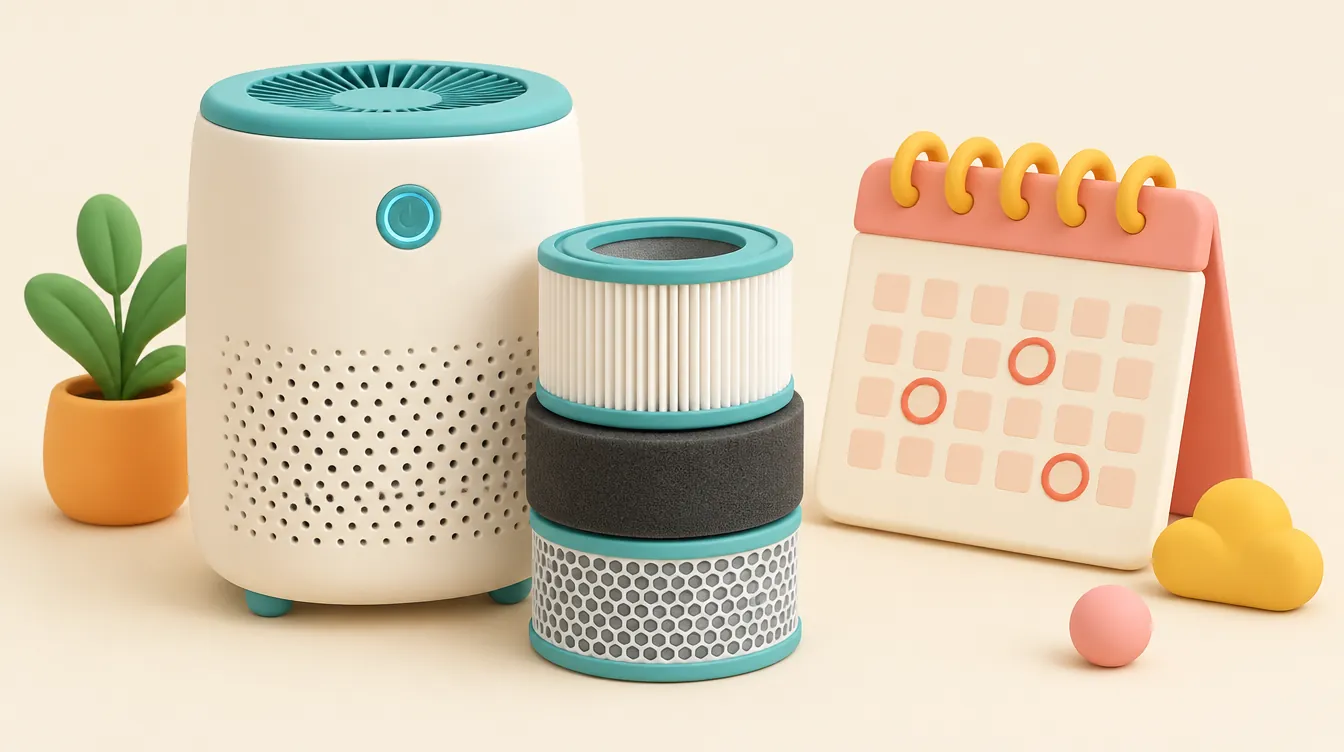
Top Pick for Long-Term Value: Coway Airmega AP-1512HH — Its 12-month True HEPA replacement schedule and bundled 3304899 filter pack (1 HEPA + 2 carbon layers) plus a washable mesh pre-filter keep two-year consumable spending lower than 6-to-8-month cylinder designs.
Runner-Up for Condition-Based Tracking: Blueair Blue Pure 311i Max — Uses the genuine F3MAX filter with a washable fabric pre-filter and Blueair's RealTrack usage algorithm, helping households running low fan speeds stretch intervals up to 9 months.
Who Should Buy Now: Shoppers willing to verify the exact replacement part number, pack quantity, and 2-year total cost before clicking "Add to Cart" on a discounted purifier.
Who Should Skip Clearance Traps: Anyone tempted by an unbranded or discontinued clearance unit whose proprietary replacement cartridge is out of stock, lacks a stated replacement interval, or costs more than 40% of the machine per change.
Top Air Purifiers & Replacement Filter Economics Compared
| Purifier Model | Exact Replacement Filter & Pack Qty | Manufacturer Interval & Pre-Filter Type | Coverage & Key Hardware Specs | Best For | Retailer & Price CTA |
|---|---|---|---|---|---|
| Coway Airmega AP-1512HH | 3304899 (1 True HEPA + 2 Carbon Filters) |
12 mo HEPA / 6 mo Carbon; washable rigid mesh pre-filter | 361 sq ft; 4-stage intake, 24.4–53.8 dB, 16.8 x 18.3 x 9.6 in | Lowest 2-year consumable cost | Best Buy: $179.99 (MSRP $229.99) |
| Blueair Blue Pure 311i Max | F3MAX (1-Pack Combined Particle + Carbon) |
6–9 mo (RealTrack algorithm); washable fabric pre-filter | 387 sq ft; 360° intake, 23–50 dB, 19.0 x 10.6 x 10.6 in | Medium-to-large bedrooms & living areas | Target: $199.99 (MSRP $229.99) |
| Levoit Vital 100 | Vital 100-RF (1-Pack 3-Stage Cartridge) |
6–8 mo; washable pre-filter layer (assembly not washable) | 300 sq ft; 3-stage filtration, 23–50 dB, 12.8 x 6.4 x 16.1 in | Compact bedrooms & home offices | Amazon: Check Live Price on Amazon |
| Blueair Blue Pure 411i Max | F4MAX (1-Pack Combined Particle + Carbon) |
6–9 mo (RealTrack algorithm); washable fabric pre-filter | 219 sq ft; 360° intake, 18–46 dB, 19.0 x 10.6 x 10.6 in | Small nurseries & dorm rooms | Target: $119.99 (MSRP $139.99) |
| Winix 5500-2 | 116130 Filter H (1 True HEPA + 1 Washable AOC Carbon) |
12 mo HEPA; washable fine mesh + washable AOC carbon | 360 sq ft; PlasmaWave & odor sensor, 27.8 dB min, 15.0 x 8.2 x 23.6 in | Pet odors & multi-year budget control | Walmart: $159.99 (MSRP $249.99) |
Interactive Tool: Multi-Scenario Air Purifier & Filter Budget Calculator
Use this calculator to compare upfront hardware discounts against multi-year replacement filter costs across three usage scenarios—without guessing your exact household air quality in advance. Select a model preset or enter the live filter box price, pack quantity, and manufacturer replacement interval from your shortlist.
Air Purifier Total Ownership Cost Estimator
Compare Manufacturer Baseline vs. Heavy-Use (+1 change) and Light-Use (-1 change) budgets.
Core Budgeting & Compatibility Rules Before You Buy
Most shoppers calculate air purifier deals backward. They spot a $40 markdown at Target or a seasonal flash sale on a compact bedroom unit, buy the appliance, and only discover six months later that its proprietary replacement cylinder costs $55 a pop and ships from a single seller. Air purifiers are razor-and-blade appliances: the upfront machine price represents only half of your two-year budget, and sometimes less than a third of your three-year outlay.
To price air purifier filter costs accurately before buying, open the manufacturer's official replacement-filter product page for every machine on your shortlist and record four hard data points: the exact part number, the confirmed compatible purifier model, the pack quantity, and the current delivered price. Similar product names inside the same brand lineup do not establish cross-compatibility. Levoit's Vital 100 (Vital 100-RF) and Vital 100S (Vital 100S-RF) look nearly identical in product thumbnails, yet their filter geometries and retention setups differ. Likewise, Blueair's Blue Pure 311i Max (F3MAX) cannot accept older Blue Pure 311 Auto filters without violating the manufacturer's sealing spec.
Once you have the exact SKU, normalize every listing to cost per complete replacement rather than price per box. A $64 two-pack of genuine cartridges works out to $32 per change, beating a $44 single-pack cartridge even if the box sticker looks higher at checkout. Always add shipping fees if a manufacturer store charges flat-rate delivery below a $50 or $75 threshold.
Pay close attention to washable pre-filter language. On Levoit's official Vital 100 replacement filter page, the brand explicitly identifies the pre-filter as washable while specifying a 6-to-8-month replacement cycle for the Vital 100-RF cartridge. That wording is not a statement that the entire filter assembly can be rinsed under a faucet. Wetting pleated electrostatic or HEPA-grade media destroys fiber structure and ruins pressure drop; only the outer pre-filter layer or detachable mesh grid is washable, and recurring replacement purchases remain mandatory.
Finally, treat manufacturer replacement intervals as conditional planning assumptions rather than fixed calendar promises. Blueair's Blue Pure Max guidance explains that its models calculate filter life differently depending on model generation and that actual usage speed, run hours, and local particle concentrations alter replacement timing. A 24/7 nursery purifier near a busy highway will saturate media months earlier than a guest-bedroom unit run four hours a night on low speed.
| Budget Line | What to Record | Why It Belongs in the Comparison |
|---|---|---|
| Purifier Hardware | Current sale price, MSRP, and confirmation of 1 included filter | Establishes Day 1 capital cost before consumables begin |
| Replacement Filter SKU | Exact part number, compatible model list, and pack quantity | Prevents buying mismatched cartridges or misreading box prices |
| Replacement Timing | Model-specific interval (e.g., 6–8 mo, 6–9 mo RealTrack, 12 mo) | Sets realistic baseline vs. heavy-use replacement scenarios |
| Washable Maintenance | Which specific layer can be vacuumed or rinsed vs. discarded | Clarifies ongoing upkeep without falsely assuming zero filter spend |
How We Evaluated & Tested Ownership Value
This guide evaluates purchasing economics, consumable supply stability, and manufacturer specification transparency; we have not conducted independent laboratory particulate-filtration testing or established clinical health outcomes for these purifiers. Instead of making unverified clean-air claims, we screened leading residential models against five strict hardware and budgeting thresholds designed to eliminate overpriced traps.
First, part-number traceability: every recommended purifier had to feature an unambiguous, manufacturer-documented replacement SKU sold across at least two major national retailers (such as Target, Best Buy, Walmart, or manufacturer-direct storefronts). Units using generic "fits most" catalog descriptions or disappearing seasonal stock were disqualified immediately.
Second, complete-change cost ceiling: we calculated two-year ownership costs using current verified filter pricing, packaging counts, and shipping minimums, eliminating compact purifiers whose annual official filter spend exceeds 60% of the machine's street price.
Third, pre-filter separation: we prioritized chassis designs that physically separate a cleanable pre-filter layer—either a washable fabric sleeve (Blueair), a rigid slide-out mesh screen (Coway and Winix), or a cleanable pre-filter surface (Levoit)—so large lint, dust bunnies, and pet hair do not prematurely clog the expensive inner pleated stage.
Fourth, acoustic and footprint honesty: we compared manufacturer-rated minimum and maximum decibel levels (18 dB to 53.8 dB across this group), AHAM-aligned room-size ratings (219 to 387 sq ft), and physical housing footprints so buyers do not under-size a machine and end up running it on Turbo 24 hours a day—which cuts filter life short.
Fifth, subscription transparency: we checked whether quoted filter discounts required recurring auto-ship enrollments or applied only to first-time sign-ups, ensuring our baseline budgets reflect repeatable out-of-pocket retail prices rather than intro-only coupons.
In-Depth Reviews: 5 Air Purifiers Ranked by Filter Budget Clarity
1. Coway Airmega AP-1512HH (Best Multi-Year Filter Economics)
If your primary goal is keeping three-year air purifier filter costs predictable and low, the Coway Airmega AP-1512HH (AP-1512HH) sets the benchmark for consumable discipline. While many modern cylinder purifiers fuse the fine particle media and carbon layer into a single 6-to-8-month cartridge, Coway separates its filtration stack into a rigid, slide-out washable pre-filter mesh, replaceable activated carbon deodorization sheets, and an independent True HEPA filter rated for a 12-month cycle.
That mechanical separation changes your replacement math immediately. Coway's official 3304899 replacement pack bundles one True HEPA filter alongside two carbon filters—matching the six-month carbon interval and twelve-month HEPA interval in a single box priced around $49.99 to $59.99 at Best Buy and Coway direct. Over a 24-month period on the manufacturer's baseline schedule, you buy just one 3304899 pack after the factory-installed set completes its first year, keeping total two-year ownership near $229.98 when paired with a $179.99 sale price (MSRP $229.99). Even in a heavy-use scenario requiring two replacement packs over 24 months, total outlay stays below $280.
Physically, the AP-1512HH measures 16.8 x 18.3 x 9.6 inches and weighs 12.3 pounds inside a matte ABS plastic shell rated for rooms up to 361 square feet. Its built-in air quality sensor rings shift color with indoor particle spikes, and Eco Mode stops the fan entirely when the room remains clean for 30 minutes—directly preserving filter hours in low-dust homes. Noise ranges from a whisper-quiet 24.4 dB on speed 1 to an audible 53.8 dB on speed 3.
Honest Flaws & Dealbreakers: The AP-1512HH's bright LED ring cannot be fully blacked out without pressing the dedicated indicator-off button, and its 2010s boxy aesthetic takes up noticeably more floor depth than cylindrical competitors. More importantly, if you skip vacuuming or rinsing the outer mesh pre-filter every two to four weeks, pet hair will slip past the perimeter and load up the carbon sheet prematurely.
2. Blueair Blue Pure 311i Max (Best Condition-Aware Replacement Tracking)
The Blueair Blue Pure 311i Max (311i Max) tackles the biggest flaw in rigid calendar timers: households do not run their purifiers identically. Instead of flashing a dumb 4,320-hour countdown LED, Blueair's Blue Pure Max series uses its proprietary RealTrack algorithm, which combines fan speed, cumulative runtime, and real-time particulate pollution readings to estimate filter life between 6 and 9 months. According to Blueair's official Blue Pure Max guidance, both usage intensity and indoor environment conditions govern when the genuine F3MAX filter actually reaches end-of-life.
From a budgeting perspective, that 6-to-9-month window creates a meaningful spread. At a typical Target sale price of $199.99 (MSRP $229.99) and an F3MAX replacement filter MSRP around $54.99, a light-to-moderate household stretching changes to 9 months buys two replacement cartridges over two years ($309.97 total). A smoky or heavy-pet household running high fan speeds and changing filters every 6 months buys three replacement cartridges over that same 24-month span ($364.96 total). Modeling both scenarios before purchase prevents sticker shock in Year 2.
The 311i Max stands 19.0 inches tall with a 10.6-inch circular footprint, weighs 7.8 pounds, and covers up to 387 square feet with a 360-degree lower intake. Its outer textile sleeve acts as a genuine washable fabric pre-filter—available in multiple muted weave colors—that traps lint and pet fur before air hits Blueair's HEPASilent electrostatic-mechanical cylinder. Acoustic output stays notably refined, measuring 23 dB on low and capping at 50 dB on high.
Honest Flaws & Dealbreakers: Because the F3MAX fuses particle media and activated carbon into one drum, you cannot replace the carbon stage separately if cooking odors saturate it early. Additionally, Blueair offers subscription discounts on its direct store, so buyers comparing Target or direct prices must verify whether a promotional F3MAX rate drops back to full MSRP on the second shipment.
3. Levoit Vital 100 (Best Compact Box-Style Option with Washable Pre-Filter Care)
The Levoit Vital 100 (Vital 100) remains a staple for bedrooms, nurseries, and home offices up to 300 square feet thanks to its slim 12.8 x 6.4 x 16.1-inch rectangular chassis and 9.3-pound weight. It draws air through a front-facing intake rather than a 360-degree barrel, making it easy to tuck flush against a nightstand or bookcase without blocking airflow. Noise levels span 23 dB on sleep mode to 50 dB at maximum fan speed.
For budgeting, Levoit explicitly ties this chassis to the Vital 100-RF replacement filter and recommends changing it every 6 to 8 months. Crucially, Levoit's Vital 100 filter documentation highlights a washable pre-filter, which many hurried shoppers misread as a license to wash the entire 3-stage block. Only the outer pre-filter layer is designed for cleaning; the inner pleated filter and activated carbon honeycomb degrade immediately if soaked. Keeping the Vital 100-RF budget accurate means planning for 3 replacement filters over a 24-month ownership window (one change every 7 to 8 months), or 4 changes under heavy wildfire-smoke or multi-pet use.
Because Levoit offers multiple similarly named compact units—including the Vital 100, Vital 100S, Core 200S, and Core 300—double-checking the exact Vital 100-RF SKU on the box or product listing is mandatory. You can check current purifier and Vital 100-RF availability on Amazon (Check Live Price on Amazon) or compare direct MSRP benchmarks on Levoit.com (where the Vital 100-RF typically lists around $34.99).
Honest Flaws & Dealbreakers: Compared to the newer Vital 100S (which uses a slide-out U-shaped pre-filter screen and a different Vital 100S-RF filter), the original Vital 100 lacks app control and relies on a 6-to-8-month cartridge cycle that adds up faster over three years than 12-month units like the Coway AP-1512HH. If you plan to run the unit 24/7 on Medium or High, factor at least three Vital 100-RF boxes into your two-year budget.
4. Blueair Blue Pure 411i Max (Best Small-Room Unit—Watch the Filter-to-Unit Ratio)
Built for compact 219-square-foot bedrooms and study corners, the Blueair Blue Pure 411i Max (411i Max) shrinks Blueair's RealTrack filter monitoring and HEPASilent architecture into an ultra-quiet chassis measuring just 18 dB on low and 46 dB on high. It weighs under 7.5 pounds, swaps easily between rooms, and pairs with the exact F4MAX replacement filter plus a removable, machine-washable fabric pre-filter sleeve.
Here is where disciplined cost modeling pays off: Target frequently discounts the 411i Max to around $119.99 (MSRP $139.99), which makes it look dramatically cheaper than the 311i Max at first glance. Yet the F4MAX replacement filter retails around $34.99—meaning three replacements over two years ($104.97) equal nearly 88% of the discounted machine price. Under heavy 6-month usage, your two-year filter spend actually surpasses the upfront cost of the purifier.
That does not make the 411i Max a bad buy for a small 180-square-foot nursery where 18 dB night acoustics matter; it simply proves why comparing upfront hardware tags alone distorts total ownership costs. Factor two to three F4MAX cartridges into your 24-month ledger from Day 1, and confirm F4MAX stock (avoiding older 411 or 411 Auto filters that do not match the 411i Max RealTrack housing).
Honest Flaws & Dealbreakers: At 219 square feet of rated coverage, using the 411i Max in a 350-square-foot living room forces the fan onto high speed continuously, accelerating RealTrack countdowns toward the 6-month floor and erasing any upfront savings compared to stepping up to the 311i Max.
5. Winix 5500-2 (Best Washable Carbon Stage for Odor-Heavy Homes)
The Winix 5500-2 (5500-2) remains a quiet workhorse for 360-square-foot kitchens, pet zones, and apartments thanks to one standout consumable advantage: both its outer fine-mesh pre-filter and its secondary pelletized Advanced Odor Control (AOC) carbon filter are washable. Instead of throwing away a combined drum every six months because cooking grease or litter-box odors saturated the carbon layer, Winix lets you rinse the AOC grid on schedule and reserve replacement spending for the 12-month True HEPA cassette (Filter H, part 116130).
At a Walmart rollback target near $159.99 (MSRP $249.99) and an official 116130 Filter H pack typically priced around $59.99, a household following Winix's 12-month baseline schedule buys just one replacement filter over 24 months ($219.98 total), or two replacements under heavy-use conditions ($279.97 total). The chassis measures 15.0 x 8.2 x 23.6 inches, weighs 15.4 pounds, and drops to 27.8 dB on Sleep mode while offering an automatic Smart Sensor mode and optional PlasmaWave ionizer toggle.
Honest Flaws & Dealbreakers: At 23.6 inches tall and 15.4 pounds, the Winix 5500-2 looks distinctly utilitarian and requires plenty of vertical clearance. Third-party "compatible" Filter H packs flood marketplace listings at half the price, but off-brand gaskets frequently leak unfiltered bypass air around the frame—so stick strictly to verified 116130 Filter H replacements when budgeting.
What to Avoid: Fake Filter Discounts, Compatibility Traps & Subscription Gotchas
Even seasoned bargain hunters lose money on air purifier consumables by falling for four recurring retail pitfalls.
1. Confusing Similar Model Names Without Checking the Filter SKU: Manufacturers recycle chassis names across generations while silently changing filter dimensions, notch cutouts, or RFID/RealTrack seals. Before buying an appliance during a seasonal event—like those tracked in our Cyber Monday shopping checklist—verify that the exact replacement SKU (F3MAX, Vital 100-RF, 3304899, or 116130) explicitly lists your exact purifier model number on the manufacturer's specification table.
2. Counting Intro Auto-Ship Coupons as Permanent Filter Prices: Several purifier brands advertise "20% off filters" directly on product pages, but the fine print restricts that rate to your first recurring auto-ship delivery or requires committing to a 6-month subscription cadence. If your home only needs a filter every 9 or 12 months, an inflexible auto-ship schedule leaves unopened boxes piling up in a hall closet. Always read renewal prices and cancellation terms before banking an introductory discount into your multi-year budget.
3. Buying Clearance Units with Disappearing Consumables: A 50% clearance markdown on a discontinued big-box store brand looks tempting until you check replacement filter availability and discover "Out of Stock" notices across every authorized dealer. If you cannot verify at least two active, in-stock sellers for the exact OEM replacement part today, walk away from the purifier deal.
4. Assuming "Washable Pre-Filter" Means Zero Future Filter Purchases: As Levoit's Vital 100 documentation demonstrates, washable pre-filters extend the usable life of the inner pleated cartridge by catching hair and lint—they never replace the inner HEPA-grade or carbon stage. Never submerge or pressure-wash an entire multi-stage filter cartridge unless the specific model's care manual explicitly marks that exact component as washable.
Frequently Asked Questions
Does a washable pre-filter eliminate replacement-filter costs?
No: you must read the maintenance instructions for each filter component separately. Levoit's official Vital 100 replacement page identifies the outer pre-filter as washable while still specifying and selling the Vital 100-RF replacement cartridge on a 6-to-8-month schedule. Never wash an entire multi-stage filter assembly simply because one pre-filter layer is washable; follow the model's exact care instructions for every stage.
Can I use the same replacement interval for every purifier?
No—always use the guidance published for your exact purifier model. Manufacturers specify different replacement intervals and use completely different methods to calculate remaining filter life; for example, Blueair's Blue Pure Max series uses usage and environmental conditions rather than a fixed calendar countdown. Treat published month ranges as conditional planning guidance rather than a universal schedule guaranteed for every household.
How can I compare costs without guessing future filter use?
Build two or three clearly labeled budget scenarios over the same 12-to-36-month period using today's verified replacement filter prices. For example, calculate the purifier's sale price plus one replacement filter, and compare it side-by-side against the purifier's price plus two replacement filters. Keep those budgeting math scenarios separate from your actual maintenance timing, and adjust future purchases once your household's real-world filter wear becomes clear.